- Who is it for?
- Ages 8–14
- How long is it?
- 45 min
- What does it include?
- Synced read-along and a quiz
- What does it cost?
- Free — no sign-up required
About this audiobook
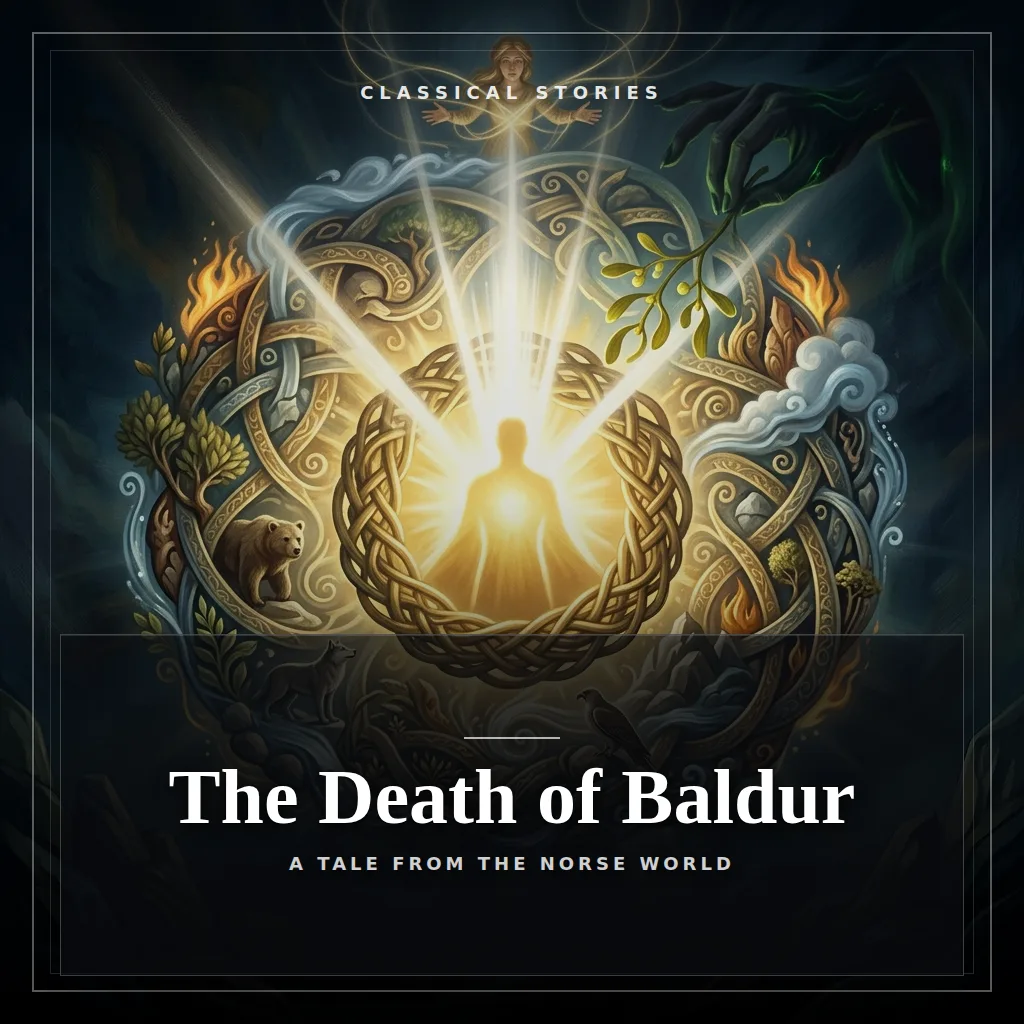
Baldur, shining and gentle, the most beloved of the gods, begins to have dreams of his own death. His mother Frigg, desperate to protect him, travels across all the worlds and extracts a promise from every element, creature, plant, and force that none will ever harm her son — all but one, the mistletoe, which she thought too young and small to bother with. Soon the gods make a game of it, hurling weapons at the invulnerable Baldur and laughing as everything bounces off. But Loki has learned of the one thing that was missed, and he guides a blind hand to throw the single dart that can pierce the unpierceable — and the whole world weeps.
Why it's worth a listen
The best-loved of all the Norse gods dreams of his own death, so his mother travels the whole world making every single thing — fire, water, iron, stone, sickness, every beast and plant — swear never to hurt him. She misses one small, harmless-looking plant. And Loki notices. The most moving story in Norse myth, about love, one overlooked detail, and grief that even the gods must face.
What listeners will learn
Subjects: world stories, literature, cultural literacy.
- character
- setting
- conflict
- choice
- consequence
- theme
- retelling
- death
- baldur
- classical
Questions for after listening
- Retell the central conflict in order.
- Name one important choice and what happened because of it.
- How did the setting or tradition shape the story?
A question to keep
Can you keep someone you love safe from everything — and what does it cost to try?
Chapters
- The Brightest Star in Asgard
- The Mother's Great Journey
- The Game of Weapons
- The Smallest Thing in the Forest
- The Shadow at the Edge of the Meadow
- The Falling of the Light
- The Ride to the Land of the Dead
- A Question to Keep
Read a transcript preview
Long ago, in the cold, wind-swept lands of the far north, where the winter night lasts for months, and the aurora dances like green fire across the sky, people gathered around open hearths to tell stories. This is a story from that Norse world, a land of deep fjords, towering pine forests, and ancient mountains. The old poets of the north, whom they called scalds, sang of a great ash tree named Yggdrasil, whose immense branches held up nine different worlds. At the very top of this tree, in a realm of golden halls and endless sky, lived the gods. They were called the Aser, and among them were mighty warriors, clever weavers, and masters of magic. But of all the gods who walked the shining streets of their city, Asgard, there was one who was loved above all others. His name was Baldur. If you were to ask the ancient Northmen what Baldur looked like, they would tell you to look at the sky just as the sun rises over a field of fresh snow. He was the god of light, of spring, and of gentle beauty. It was said that he was so fair and radiant that a soft, warm light seemed to shine directly from his skin, illuminating any room he entered. When Baldur walked through the forest, the heavy pine boughs seemed to lift, and the pale northern flowers turned their faces toward him, as if he were the sun itself. Yet, it was not his beauty alone that made him loved. It was his kindness. In a world of fierce warriors, where arguments were often settled with the sharp edge of an axe, Baldur was a peacemaker. He spoke with a voice that sounded like water flowing over smooth stones, and his judgments were always fair, wise, and filled with mercy. In his presence, anger simply melted away. Even the fiercest giants of the cold mountains and the dark elves of the underground kingdoms spoke of Baldur with a quiet sort of reverence. To look upon him was to feel safe, to feel warm, and to believe that goodness would always prevail. Baldur lived in a hall called Breidablik, which means broad gleaming. It was a place of absolute purity. No untrue word could ever be spoken within its walls, and nothing unclean or evil was permitted to cross its threshold. There, Baldur lived with his wife Nana, a woman of gentle grace who loved him with a devotion that matched his own. For many long ages, their life was a tapestry of peace and joy. But peace, even for the gods, is a fragile thing. It began on a night when the wind from the north blew colder than usual, rattling the golden shields that tiled the roofs of Asgard. Baldur retired to his bed, but sleep did not bring him rest. Instead, it brought him dreams. In the past, Baldur's dreams had been filled with light and the singing of birds. But on this night, the dream was dark. He found himself walking through a landscape where the sun had gone out. The trees were black and skeletal, and the ground beneath his feet was frozen, hard as iron. A heavy, suffocating silence hung over everything. As he walked, he felt a cold hand reach out from the shadows, touching his shoulder. A voice, whispering like dry leaves scraping across a tomb, spoke his name, calling him down into the earth. Baldur woke with a start, his heart hammering against his ribs. His brow was wet with cold sweat, and for the first time in his life, the light radiating from his skin seemed dim and flickering. He tried to shake the dream away, telling himself it was merely a shadow of the mind. But the next night, the dream returned. And the night after that, it grew even darker. In these dreams, Baldur saw his own shadow stretching out across the nine worlds, growing longer and longer until it swallowed the light of the sun entirely. He saw the great hall of Breidablik crumbling into dust, and he felt a cold gray weight pressing down upon his chest, stopping his breath. He…
Published 2026-07-11 · Updated