- Who is it for?
- Ages 8–14
- How long is it?
- 33 min
- What does it include?
- Synced read-along and a quiz
- What does it cost?
- Free — no sign-up required
About this audiobook
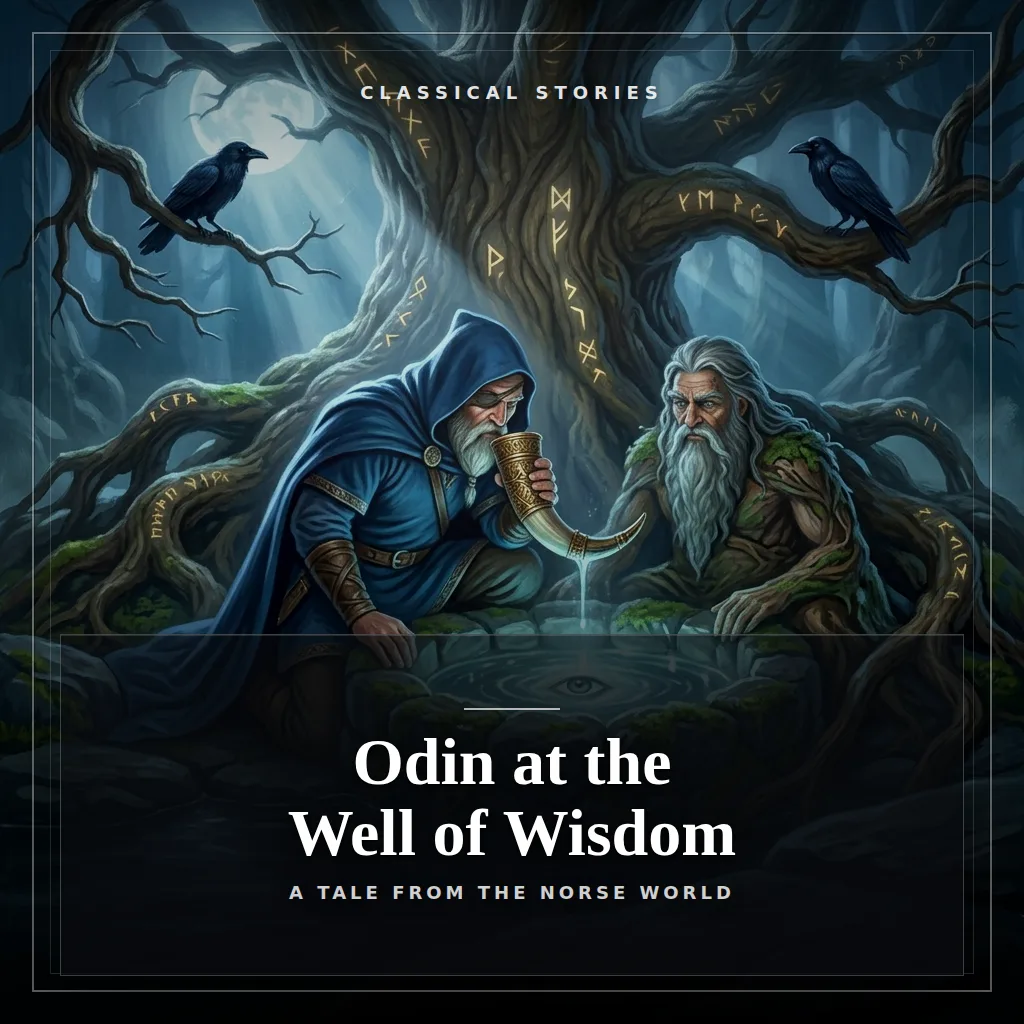
Odin, ruler of the Norse gods, is hungry above all things for wisdom and knowledge of what is to come. He journeys to the well of Mimir, whose waters hold deep understanding, and asks to drink — and the price is one of his eyes, dropped into the well forever. He pays it without hesitation. But he wants more: the secret of the runes, the sacred letters that carry all knowledge. To win them he wounds himself and hangs for nine nights and nine days on Yggdrasil, the great world-tree, giving 'himself to himself,' taking neither food nor water, until at last the runes reveal themselves to him in a cry.
Why it's worth a listen
The one-eyed king of the Norse gods was not born one-eyed. This is the story of how Odin gave an eye for a single drink from the well of wisdom, and then hung nine nights on the world-tree, wounded and alone, to win the secret of the runes — the writing that holds all knowledge. A strange, austere myth about the terrible price of understanding.
What listeners will learn
Subjects: world stories, literature, cultural literacy.
- character
- setting
- conflict
- choice
- consequence
- theme
- retelling
- odin
- well
- wisdom
Questions for after listening
- Retell the central conflict in order.
- Name one important choice and what happened because of it.
- How did the setting or tradition shape the story?
A question to keep
What would you give up to truly understand — and is any price too high for wisdom?
Chapters
- The Sky-Traveler and the Ravens
- The Roots of the World-Tree
- The Price of a Drink
- The Silent Letters
- Nine Nights on the Great Ash
- The Cry in the Dark
- A Question to Keep
Read a transcript preview
Long before the world was mapped, and long before the stars were given the names we call them by today, there was a land of ice and fire, where the wind spoke in a language of iron. This is a story from the far north, from the old Norse people who lived in the shadow of great fjords and dark pine forests, where the winter nights were so long that they seemed to swallow the sun whole. In those ancient times, people gathered around roaring hearth fires to tell tales of the gods of Asgard, the golden city that floated high above the clouds. They called these stories the Eddas, and they knew that while there were many ways to tell a tale, the truest stories were those that carved a path straight into the human heart. At the center of all these stories was Odin, the Allfather, the sovereign of the Norse gods. If you were to see him in those days, you might not have recognized him as a king. He did not sit idly on a golden throne, draped in heavy silks, counting his treasures. He was a restless God, a wanderer. He often wore a cloak of deep midnight blue, frayed at the hem by the brambles of a hundred different worlds, and a broad brimmed hat pulled down low to shadow his face. He traveled the dirt roads of Midgard, which is what the Norse people called our earth, walking among humans as a tall, quiet stranger with a long gray beard, carrying nothing but a wooden staff. But beneath his quiet disguise, Odin's mind was a tempest. He was not hungry for gold, nor did he thirst for wine or the praise of men. Odin's hunger was of a far stranger kind. He was hungry to know. He wanted to understand the secret workings of the nine worlds. He wanted to know what the birds said when they called to one another across the misty valleys, and what the ancient rocks remembered from the dawn of time. Most of all, Odin wanted to see into the future. He wanted to look down the long winding road of tomorrow and know what was coming. Not just for himself, but for everyone and everything. Hugen, who was thought, flew swift and straight, darting into the minds of kings and peasants, animals and giants, watching what they planned and what they dreamed. Munin, who was memory, flew slower, hovering over the battlefields, the quiet graveyards, the old ruins, and the cradles of newborns, gathering the stories of everything that had ever happened, ensuring that nothing was ever truly lost. All day long, Odin would wait. He would pace the floor of his palace, his mind stretching out across the void, waiting for his messengers to return. And when the sun began to sink below the horizon, painting the sky in shades of bruised purple and gold, he would hear the dry, rhythmic whisper of wings. Hugen and Munin would glide through the high windows and land softly on Odin's shoulders, their talons gripping his heavy cloak. They would lean their dark heads close to his ears, and in low, raspy whispers, they would tell him everything they had seen and heard that day. They told him of a mother singing a lullaby in a lonely cabin. They told him of a glacier groaning as it slid an inch closer to the sea. They told him of a king plotting a war in a distant land, and of a tiny field mouse gathering seeds for the winter. Odin would listen, closing his eyes, drinking in their words. But when they finished, and the silence of the night settled over the hall, the Allfather would sigh. He would look out into the darkness, his heart heavy. For all that thought and memory could bring him, it was still not enough. Thought could only see what was happening now, and memory could only hold what had already passed. Neither of them could tell him why. Neither of them could show him the grand pattern of the universe, or the secrets of what was yet to be. To find those answers,…
Editorial review
Quality reviewed · 95/100 on . Certificate EL-1950-8B7E is bound to the exact narrated script.
The review checks factual care, audience fit, teaching quality, structure, tone and source honesty. Read the editorial standards.
Published 2026-07-11 · Updated