- Who is it for?
- Ages 8–14
- How long is it?
- 35 min
- What does it include?
- Synced read-along and a quiz
- What does it cost?
- Free — no sign-up required
About this audiobook
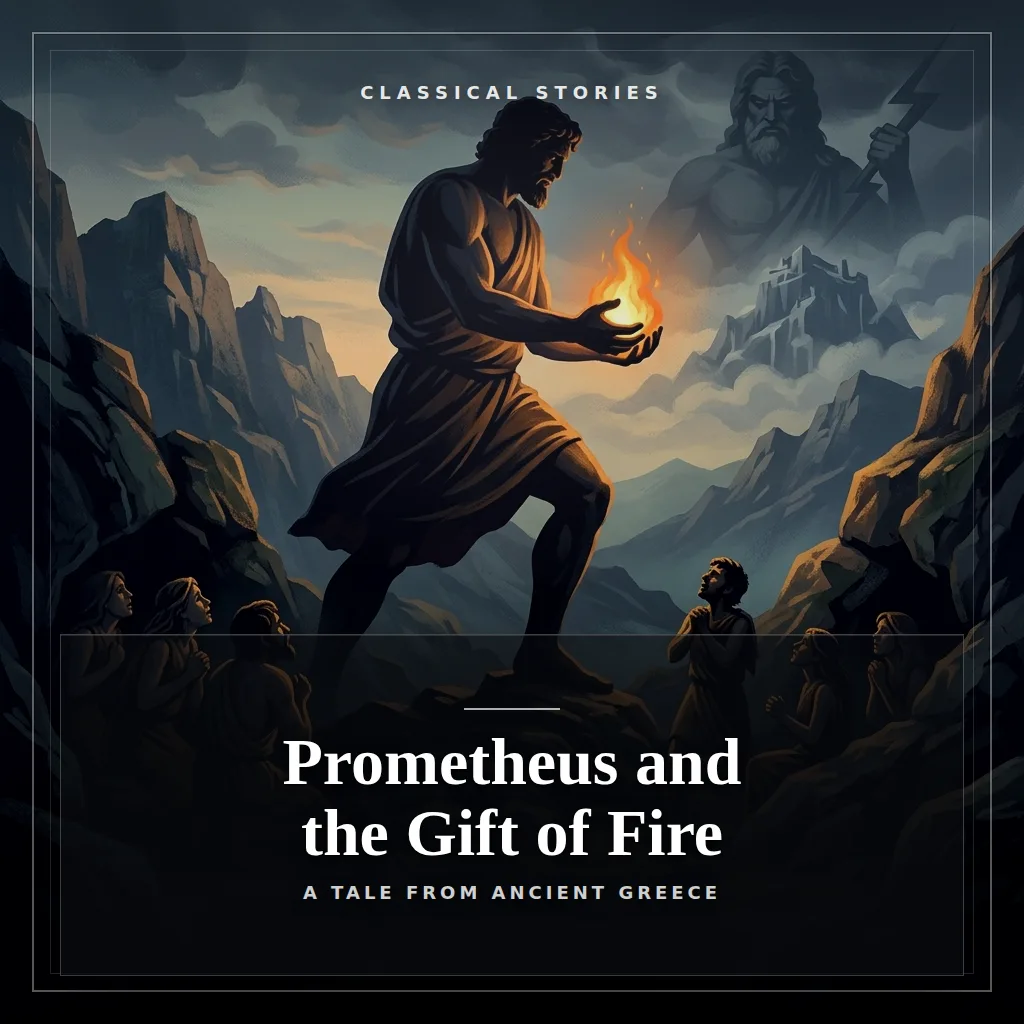
In the early days, humans shiver in the dark while the gods keep fire for themselves. Prometheus, a titan who loves the fragile mortals, tricks Zeus and then goes further: he steals fire from the heavens, hides it in a hollow fennel stalk, and brings it down to the human world. With fire come warmth, cooked food, metalworking, and the first real chance for people to thrive. But Zeus's anger is terrible, and Prometheus knew it would be — he accepts a punishment that lasts an age, chained to a rock, because the gift was worth it.
Why it's worth a listen
Humans were cold, dark, and helpless until one titan defied the king of the gods, hid a spark of fire in a hollow stalk, and carried it down to them — knowing exactly what it would cost him. The story of where warmth, cooking, and craft came from, and of the price one friend of humankind chose to pay.
What listeners will learn
Subjects: world stories, literature, cultural literacy.
- character
- setting
- conflict
- choice
- consequence
- theme
- retelling
- prometheus
- gift
- fire
Questions for after listening
- Retell the central conflict in order.
- Name one important choice and what happened because of it.
- How did the setting or tradition shape the story?
A question to keep
Is it worth suffering forever to give others something that changes everything?
Chapters
- The Shivering World
- The Counsel of the King
- The Spark in the Stalk
- The Great Awakening
- The High Crag of Scythia
- A Question to Keep
Read a transcript preview
Long before there were cities of stone or ships to sail the wine dark sea, the world was a very cold and quiet place. If you stood on a hill at night, you would see no lights twinkling in the valleys below, no smoke curling lazily toward the stars. There was only the wind, the dark, and the sound of shivering. In the ancient lands of Greece, where the mountains rise like jagged teeth into a bright blue sky, and the sea is the color of bruised grapes, people have told this story for thousands of years. They told it in different ways, around their own fires, but the heart of the tale never changed. It is the story of how humanity found its spark, and the terrible price one Titan paid to give it to us. In those primordial days, the earth was young, and the creatures who lived upon it were still finding their way. The gods lived high above the clouds on Mount Olympus, a place of endless summer, golden light, and sweet nectar. They were immortal, powerful, and very, very distant. Down below, on the damp, muddy earth, lived the mortals. To look at these early humans was to look at the most fragile things in creation. They did not have the thick warm fur of the great bears. They did not have the sharp tearing claws of the mountain lions, or the swift leaping legs of the deer. They had no shells to crawl into when the storms rolled in, and no wings to carry them away from danger. This was because of a mistake made by a giant named Epimetheus. Now, Epimetheus was one of the Titans, an ancient family of giants who ruled before the Olympian gods came to power. He had been given the task of distributing gifts to all the newly created beasts of the earth. But Epimetheus was not known for thinking ahead. In fact, his name means afterthought. He was the kind of person who acts first and regrets it later. With a big, generous heart, Epimetheus had gone through his basket of gifts. He gave strength to the mammoth, speed to the cheetah, sharp vision to the hawk, and thick armor to the tortoise. He handed out warm coats, sharp teeth, and powerful wings until his basket was completely empty. Only then did he look down and see the humans. They stood naked in the tall grass, trembling in the autumn breeze. They had no claws to dig for roots, no fur to keep out the frost, and no natural weapons to defend themselves against the wolves howling in the shadows. Epimetheus realized with a cold shock of panic that he had saved nothing for them. They were entirely defenseless. Distressed, Epimetheus went to his brother, Prometheus. Prometheus was very different from his brother. His name means forethought. He was a Titan who looked ahead, who saw the ripples of the future before they even touched the shore of the present. He was wise, quiet, and deeply patient. But more than that, Prometheus had a quality that was rare among the giants, and almost entirely missing among the gods. He had empathy. When Prometheus looked down from the high ridges of the mountains and saw the humans, his heart did not fill with pity, but with a deep, protective love. He did not see them as useless or weak. He saw them as unfinished. He watched them huddle together in the deep, damp caves, pressing their bodies against one another to share what little warmth they had. He saw them eating raw roots and tough, cold meat, their teeth wearing down, their bellies aching. He watched them flinch at every roll of thunder, terrified of the sky, terrified of the dark, terrified of the very world they had been born into. "They cannot survive like this," Prometheus whispered to himself, his dark eyes reflecting the gray mist of the valleys below. "They are living like beasts, but they have the minds of angels. They have stories inside them, but they are too cold to speak them. They have songs, but their teeth are chattering too hard to sing."…
Editorial review
Quality reviewed · 96/100 on . Certificate EL-14C0-7E76 is bound to the exact narrated script.
The review checks factual care, audience fit, teaching quality, structure, tone and source honesty. Read the editorial standards.
Published 2026-07-11 · Updated