- Who is it for?
- Ages 8–14
- How long is it?
- 45 min
- What does it include?
- Synced read-along and a quiz
- What does it cost?
- Free — no sign-up required
About this audiobook
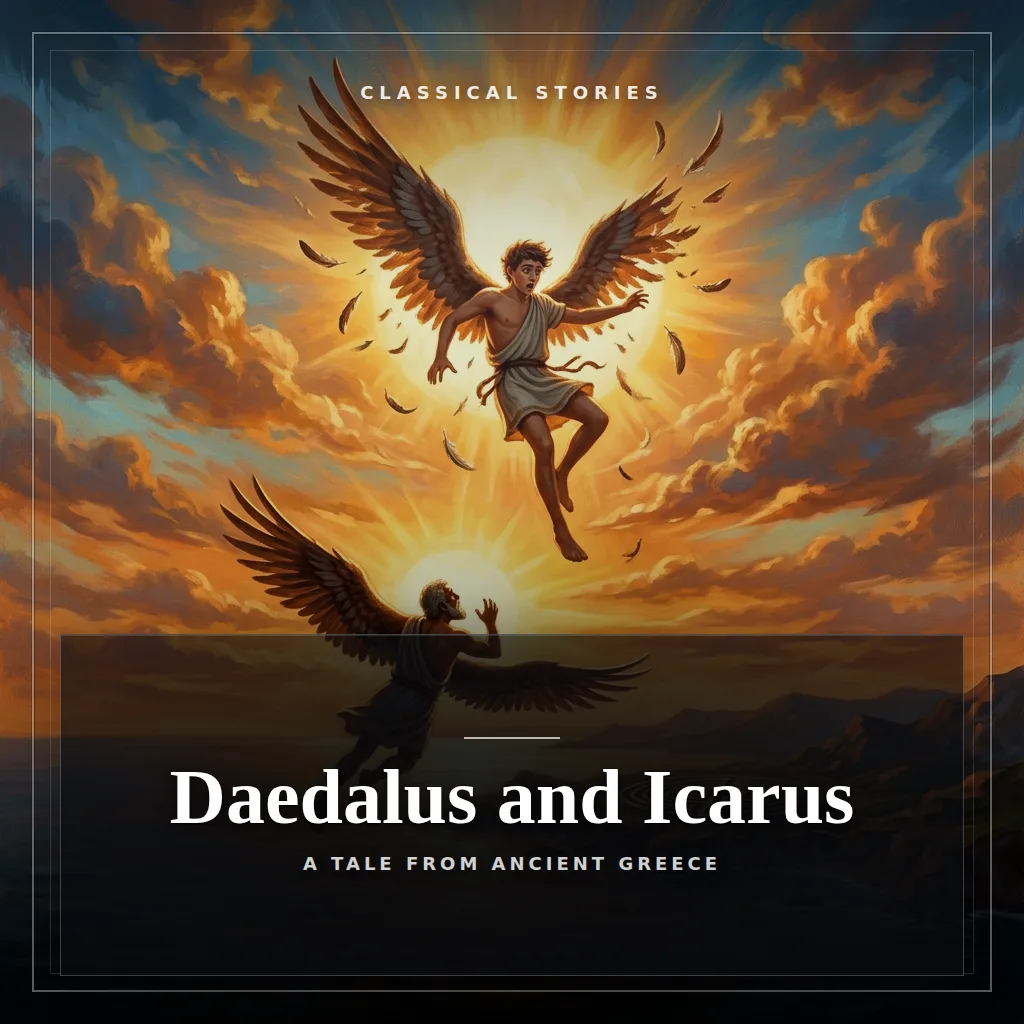
Daedalus, the genius who built the labyrinth, is imprisoned on Crete with his son Icarus by the king he once served. No ship can slip past Minos, no road leads off an island — so Daedalus looks up. He builds two pairs of wings from gathered feathers and wax, and gives his son one gift and one warning: fly the middle way. Not so low that the sea soaks the feathers; not so high that the sun melts the wax. The flight begins in terror, turns to joy — and joy is exactly the danger.
Why it's worth a listen
The most famous flight in mythology: wings built from feathers and candle wax by the greatest inventor who ever lived, locked in a tower of his own designing. It is thrilling, then heartbreaking — and it leaves behind one of the oldest questions families have ever shared: why is 'not too high' the hardest instruction in the world?
What listeners will learn
Subjects: world stories, literature, cultural literacy.
- character
- setting
- conflict
- choice
- consequence
- theme
- retelling
- daedalus
- icarus
- classical
Questions for after listening
- Retell the central conflict in order.
- Name one important choice and what happened because of it.
- How did the setting or tradition shape the story?
A question to keep
When someone you love gives you both a gift and a warning, why is the warning so hard to keep?
Chapters
- The High Cage of Crete
- The Secret of the Gulls
- The Gift and the Warning
- The Kingdom of the Air
- The Melting of the Wax
- The Icarian Sea
- A Question to Keep
Read a transcript preview
If you were to stand on the highest cliffs of the island of Crete and look out across the Aegean Sea, you would see a world made of two colors, the deep, endless blue of the water and the bright, blinding blue of the sky. It is a beautiful place, but to a prisoner, beauty can be the sharpest part of the cage. Thousands of years ago, in the time we now call the age of the Greek myths, a man stood at the narrow window of a stone tower and looked out at those two blues. His name was Daedalus, and he was, without a doubt, the greatest inventor, builder, and craftsman the world had ever known. In the land of ancient Greece, people spoke of Daedalus with a kind of quiet wonder. They said he could carve statues of wood and stone that were so lifelike, they seemed to breathe. People swore they saw the statues' eyes blink in the sunlight, or their stone limbs move when no one was watching. He had invented the plum line for builders, the axe and the sail yard for ships. If there was a problem that could not be solved, a lock that could not be opened, or a structure that could not be built, people sent for Daedalus. And that was exactly why he was locked in a tower. He had been brought to the island of Crete by its ruler, King Minos. Minos was not a simple villain, nor was he a cruel monster for the sake of being cruel. He was a king who loved order, power, and security above all things. He wanted his kingdom to be safe, his enemies to be helpless, and his secrets to be kept forever. To do this, he needed the mind of Daedalus. "Build me a prison," King Minos had commanded the inventor years before. "A prison so complex, so winding, and so dark that anyone who enters it will wander forever, lost in its turns, unable to ever find the light of day." So, Daedalus had built the labyrinth. It was a masterpiece of stone and shadow, a maze that curved and twisted back on itself like a sleeping serpent. It was built to hold the Minotaur, a creature half man and half bull, but it was also built to keep secrets. And for a long time, the labyrinth worked exactly as the king desired. But secrets have a way of wanting to be free. If you have heard the story of the hero Theseus, you know that he came to Crete, entered the dark passages of the labyrinth, and did what no one else had ever done. He found his way out. He did it because of a simple ball of silken thread, a thread that guided him back through the dark to the entrance. What King Minos knew, and what made his blood run cold with anger, was that Theseus could never have thought of the thread on his own. Someone had told him the secret of the maze. Someone had whispered how to conquer the great work of stone. That someone was Daedalus. Daedalus had not done it out of hatred for the king, but out of pity for the young people who were sent into the maze. But to King Minos, pity was a form of treason. "You know the secrets of my kingdom," Minos had declared, his voice cold as iron. "You know every turn of the labyrinth, every hidden door in my palace, every harbor on my coast. If you leave Crete, you will give those secrets to my enemies. Therefore, you will never leave." Minos did not execute the great inventor. He was too wise to destroy such a valuable mind. Instead, he locked Daedalus away in the high tower that stood on the cliffs, overlooking both the sea and the very labyrinth the inventor had built. And because the king knew how much Daedalus loved his family, he locked up Daedalus's young son, Icarus, along with him. For years, the tower was their world. Icarus had grown from a small child into a bright, restless boy within those stone walls. He was…
Editorial review
Quality reviewed · 91/100 on . Certificate EL-EC95-E87E is bound to the exact narrated script.
The review checks factual care, audience fit, teaching quality, structure, tone and source honesty. Read the editorial standards.
Published 2026-07-10 · Updated