- Who is it for?
- Ages 8–14
- How long is it?
- 45 min
- What does it include?
- Synced read-along and a quiz
- What does it cost?
- Free — no sign-up required
About this audiobook
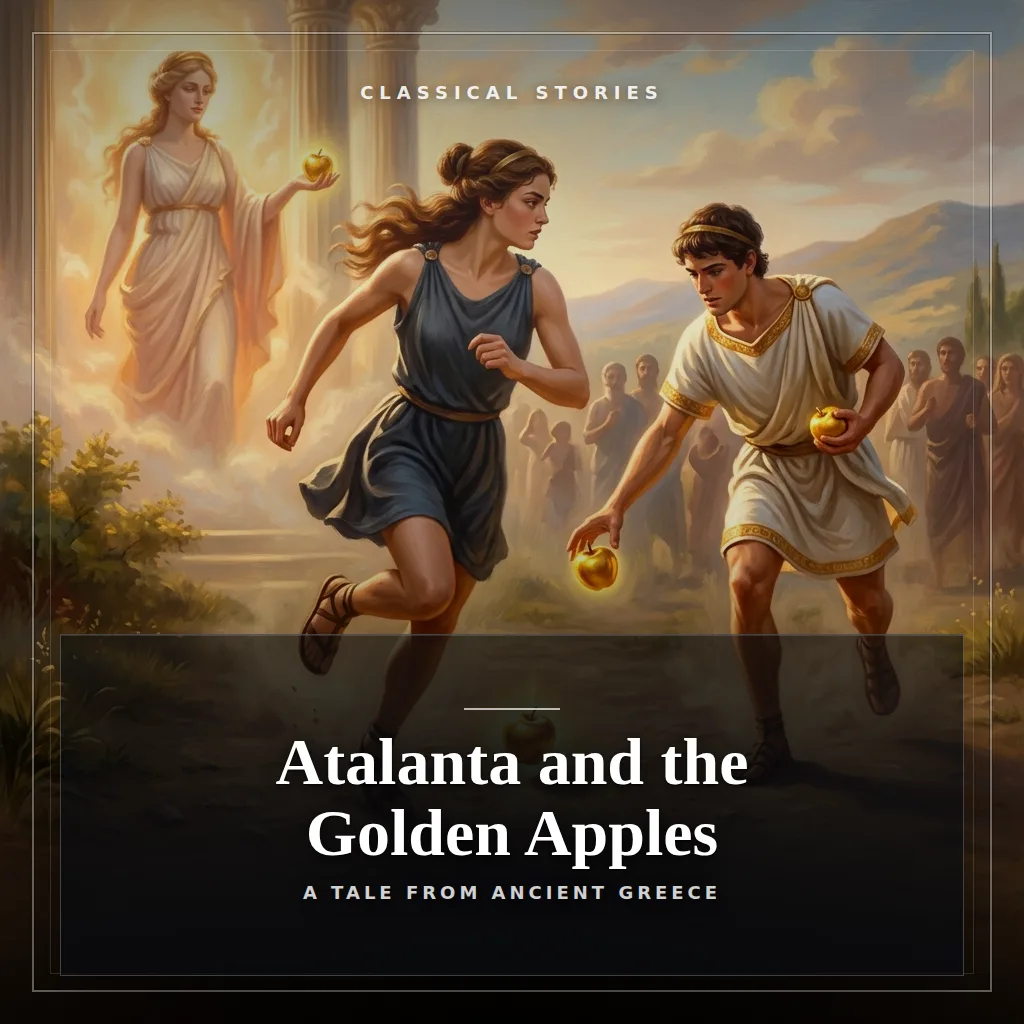
Abandoned as an infant and raised by a bear and then by hunters, Atalanta becomes the swiftest, fiercest runner in Greece — she joins heroes on the boar hunt and outruns them all. Told she must marry, she sets a condition: she will race any suitor, and only one who outruns her may claim her; those who lose, lose everything. Many try; none win. Then Hippomenes prays to the goddess of love, who gives him three golden apples. Each time Atalanta pulls ahead, he rolls one glittering apple aside, and each time — just for a heartbeat — she cannot help stooping to look.
Why it's worth a listen
Left on a mountain as a baby and raised by a bear, Atalanta grows into the fastest runner alive — so fast she agrees to marry only the man who can beat her in a race, knowing none can. Then one suitor brings three golden apples and a plan. A story about a fierce, free heroine and the one thing that finally makes her look aside.
What listeners will learn
Subjects: world stories, literature, cultural literacy.
- character
- setting
- conflict
- choice
- consequence
- theme
- retelling
- atalanta
- golden
- apples
Questions for after listening
- Retell the central conflict in order.
- Name one important choice and what happened because of it.
- How did the setting or tradition shape the story?
A question to keep
What makes someone slow down for the first time — and is it worth it?
Chapters
- The Mountain of the She-Bear
- The Calydonian Boar
- The Price of the Wind
- The Prayer of Hippomenes
- Three Sparks of Gold
- A Question to Keep
Read a transcript preview
If you were to stand on the high rocky slopes of Mount Parthenian under the cold bright stars of ancient Greece, you might hear a sound that does not belong to the wind. It is not the long low howl of a wolf, nor the sharp cry of an eagle nesting in the crags. It is the sound of light rhythmic footsteps, patter pat, patter pat, moving so fast across the stones that they sound like rain falling on dry leaves. This is a story from ancient Greece, a land of high mountains, deep blue seas, and gods who watched from the clouds. Like all the best stories, it has been told in many different ways over the thousands of years since it first began. In some tellings, the hero of this tale is a princess. In others, she is a wild huntress of the woods. But in every telling, she is Atlanta, the swiftest runner who ever lived. And her story begins not in a palace, but on a cold, lonely mountainside, where no child was ever meant to survive. Long ago, there ruled a king named Iasus. He was a proud man, a warrior king, who wanted nothing more than a son, a prince who would carry his heavy bronze shield, lead his armies into battle, and inherit his crown. When the queen gave birth, the king rushed to the cradle, his iron sandals clanking on the stone floor. But when he looked down, he did not see a baby boy. He saw a tiny, fragile girl with eyes as bright as obsidian, and a crown of dark, downy hair. King Iasus turned away in anger. In those harsh ancient times, some rulers believed that a daughter was of no use to a kingdom. Take her away, the king commanded his servants, his voice cold as winter frost. Take her to the highest peak of Mount Parthenian. Leave her there, where the wind howls and the rocks are sharp. Let the mountain have her. The servants dared not disobey the king. With heavy hearts, they carried the baby up the winding rocky paths of the mountain, far above the tree line, where the air grew thin and freezing. They laid her down on a bed of dry pine needles in the shadow of a great gray cliff. Turned their backs and walked away, leaving the infant to the mercy of the wild. But the mountain was not empty. High up in a cave of dark stone, lived a great she bear. She was a massive creature with fur the color of old earth, and claws that could split a log. Only a day before, hunters had taken her cubs, and her heart was heavy with a deep, aching grief. Her mother's instinct was a fire burning inside her. As she wandered the rocky ledges, searching for the whimpering cries of her lost little ones, she heard a new sound. It was a thin, sharp cry rising from the pine needles. The bear lumbered down the slope. Her heavy paws shook the pebbles. She approached the baby, her wet black nose twitching as she sniffed the strange hairless creature. The infant did not have claws, or fur, or sharp teeth, but she was small, she was cold, and she was crying. Slowly, gently, the great beast nudged the baby with her snout. The baby reached out with a tiny warm hand and caught a tuft of the bear's thick coarse fur. The bear did not bite. Instead, she lay down beside the child, wrapping her massive warm body around the shivering infant. She nudged the baby close and let her nurse. In that dark, wild place, under the cold Greek stars, an extraordinary bond was forged. The princess of the palace became the daughter of the mountain. The hunters were amazed. They did not see a monster. They saw a miracle. Over many weeks, they returned to the high slopes, leaving gifts of sweet berries, roasted meat, and soft deer skins near the cave. Gradually, the wild girl grew curious. She began to watch them from the branches of the pine trees. She saw that they walked on two…
Published 2026-07-11 · Updated