- Who is it for?
- Ages 8–14
- How long is it?
- 42 min
- What does it include?
- Synced read-along and a quiz
- What does it cost?
- Free — no sign-up required
About this audiobook
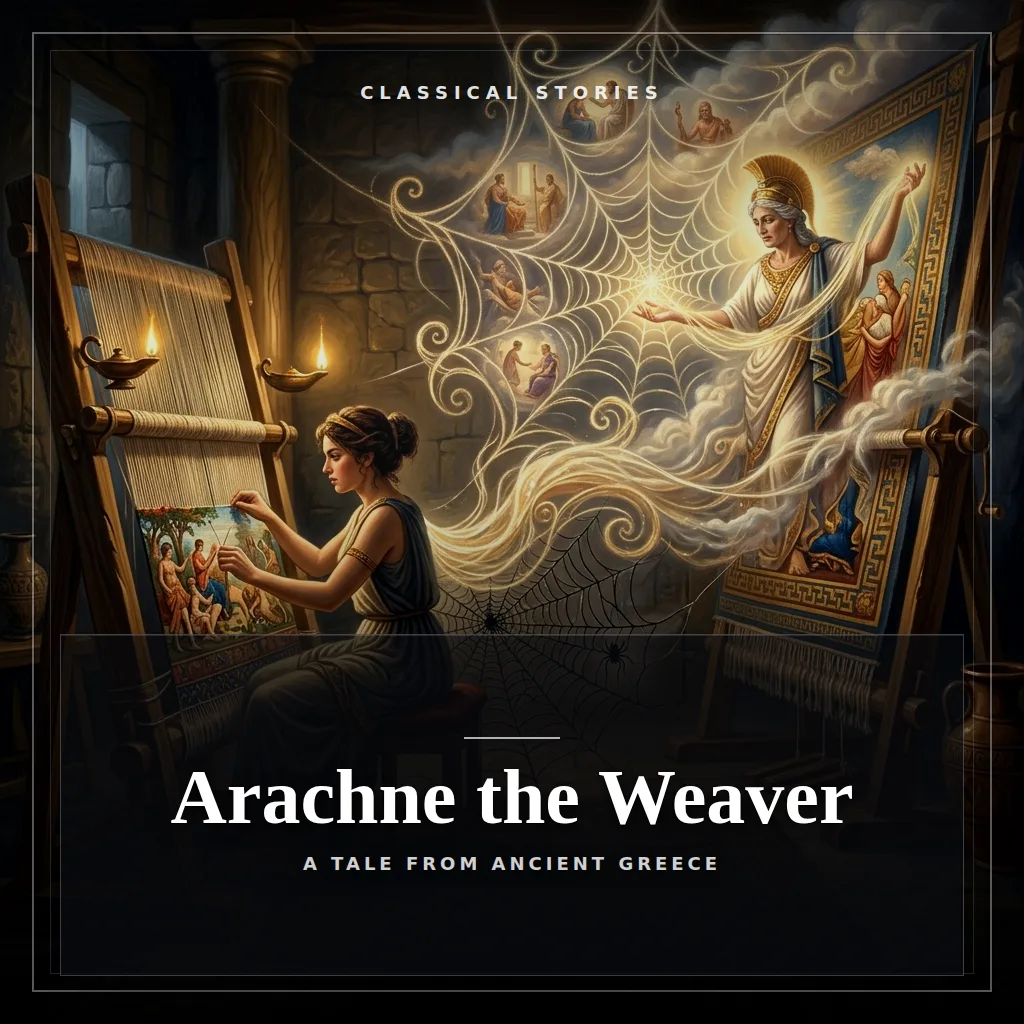
Arachne is the finest weaver anyone has seen, and she knows it — so well that when people credit the goddess Athena, she scoffs and boasts she could beat the goddess in a contest. Athena, disguised as an old woman, warns her to show humility; Arachne refuses. So the goddess reveals herself and the contest begins. Both weave dazzling cloth — Athena's showing the glory of the gods, Arachne's showing the gods behaving badly. The girl's work is flawless, even daring. And the outcome turns Arachne into the first of all the spiders, still weaving to this day.
Why it's worth a listen
A village girl weaves so beautifully that people say the goddess Athena herself must have taught her — and she makes the mistake of saying she taught herself, and could out-weave the goddess too. What happens at that loom is a story about talent, pride, and why the first spider spins.
What listeners will learn
Subjects: world stories, literature, cultural literacy.
- character
- setting
- conflict
- choice
- consequence
- theme
- retelling
- arachne
- weaver
- classical
Questions for after listening
- Retell the central conflict in order.
- Name one important choice and what happened because of it.
- How did the setting or tradition shape the story?
A question to keep
Where is the line between being proud of your gift and being blind to everyone else's?
Chapters
- The Girl Who Spun the Wind
- The Whisper in the Thread
- The Shadow at the Loom
- The Clash of Shuttles
- Two Worlds Woven
- The Web in the Morning Dew
- A Question to Keep
Read a transcript preview
Long ago, in a sun-drenched valley of ancient Greece, there lived a girl whose fingers could do what no one else on earth could manage. They could turn rough, tangled sheep's wool into golden light. Her name was Arachne, and she lived in a quiet, dusty town called Hypa, nestled at the foot of Mount Tmolus. In this valley, the summers were long and hot, and the winter winds carried the scent of pine and wild thyme down from the peaks. But if you walked through the narrow, stony streets of Hypa on any afternoon, you would not hear the wind. You would hear only the steady, rhythmic clack, clack, clack of a wooden loom, and the soft musical whistle of a wooden shuttle flying back and forth between threads. To the people of ancient Greece, whose stories we still tell today in many different ways, each storyteller adding a thread of their own, Arachne was not just a weaver. She was a wonder. She was not born into wealth or royalty. Her father, Idmon of Colophon, was a humble man who made his living by dying wool. It was a messy, smelly trade. All day long, Idmon stood over great steaming iron cauldrons, stirring boiling water infused with the crushed shells of sea snails. This was the famous Tyrian purple, a dye so rich and deep that it seemed to change color in the sun, shifting from the dark red of a bruised plum to the brilliant violet of a twilight sky. Idmon's hands were stained, permanently stained, a dark bruised grape color, and the scent of the sea and the vinegar sharp dye hung constantly about his small stone cottage. But while the father worked with the heavy, wet weight of the dye pots, the daughter worked with air and light. Even as a small child, Arachne had shown a strange, almost magical relationship with wool. While other children ran through the olive groves or played with knuckle bones in the dirt, Arachne would sit on a low stool by her father's workshop, holding a bundle of raw fleece. To anyone else, the fleece was a dirty, greasy tangle, full of burrs and stickers from the hillside pastures. But to Arachne, it was a treasure chest of possibilities. First, she would card the wool, drawing it through iron combs to straighten the fibers. The onlookers who gathered around her cottage would watch in silence as her fingers moved. She did not tug or tear at the knots. Instead, her hands coaxed the wool, smoothing it out until the rough pile became as soft, white, and airy as a summer cloud caught in the branches of a tree. Next came the spinning. Arachne would attach the cloud of wool to her distaff, a wooden rod held under her arm, and suspend a weighted spindle below. With a gentle flick of her wrist, she would set the spindle spinning. It would drop toward the dirt floor, whirling like a top. And as it spun, Arachne's fingers would draw out the fibers, twisting them into a thread so fine, it was nearly invisible. If you stood a few feet away, it looked as though she were spinning the very air, pulling a silver cord out of nothingness. But the real magic happened when she sat at her loom. The loom was a tall, upright wooden frame. The vertical threads, called the warp, hung down from the top bar, weighted at the bottom with heavy clay stones to keep them taut. Arachne sat before this frame like a musician before a harp. Her fingers did not seem to touch the wood or the wool, so much as dance across them. When she wove, she did not just create cloth. She painted pictures. She would take her father's purple wool, and wool she had dyed herself with the yellow of wild saffron, the green of crushed ivy leaves, and the soft blue of woad. With these threads, she would weave landscapes that looked more real than the world outside her window. She would weave a forest where the leaves seemed to tremble in an invisible breeze. She would weave a stream where the…
Editorial review
Quality reviewed · 96/100 on . Certificate EL-14A1-852F is bound to the exact narrated script.
The review checks factual care, audience fit, teaching quality, structure, tone and source honesty. Read the editorial standards.
Published 2026-07-11 · Updated