- Who is it for?
- Ages 8–14
- How long is it?
- 38 min
- What does it include?
- Synced read-along and a quiz
- What does it cost?
- Free — no sign-up required
About this audiobook
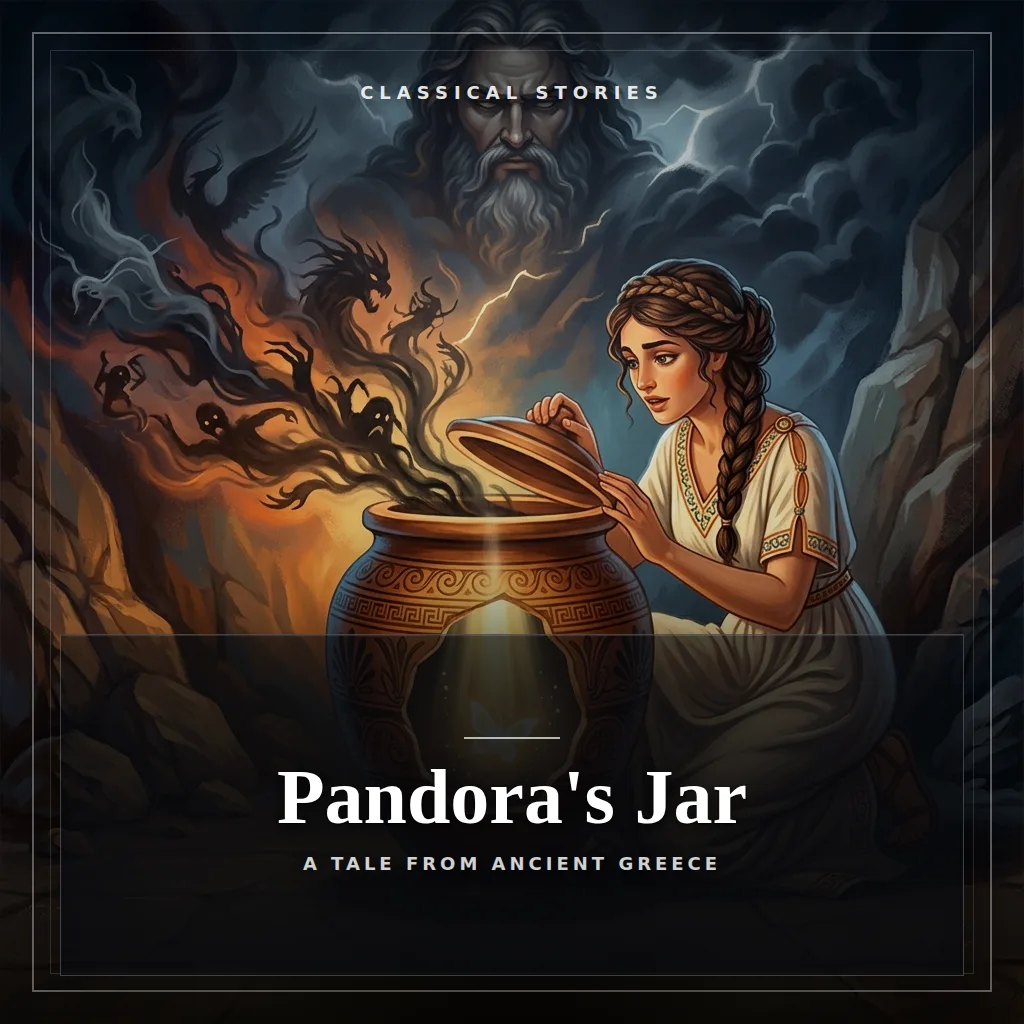
In the first days, the gods make Pandora, the first woman, and give her every gift — grace, cleverness, curiosity — and one sealed jar, with the single instruction never to open it. For a while she resists. But the jar seems to whisper, and curiosity is the strongest gift the gods gave her. When at last she lifts the lid just a crack, out pour all the troubles that had never existed before — and she slams it shut in terror on the one thing still inside, which turns out to be the thing the world will need most.
Why it's worth a listen
The Greek story of how sorrow, sickness, and worry first came into a world that had none — and why, when the last of them had flown out, one quiet thing was still waiting at the bottom of the jar. A myth about curiosity, blame, and the small stubborn gift that keeps people going.
What listeners will learn
Subjects: world stories, literature, cultural literacy.
- character
- setting
- conflict
- choice
- consequence
- theme
- retelling
- pandora
- classical
- stories
Questions for after listening
- Retell the central conflict in order.
- Name one important choice and what happened because of it.
- How did the setting or tradition shape the story?
A question to keep
Once trouble is loose in the world, what is left that makes it bearable?
Chapters
- Introduction
- The Golden Age of No
- The Clay and the Breath
- The Gift That Whispered
- The Song in the Clay
- The Shadow on the Wind
- The Winged Thing at the Bottom
- A Question to Keep
Read a transcript preview
Number 33. Pandora's Jar. Imagine a world where no one has ever had a cold, or a bad dream, or a secret they had to keep. Imagine a sky that never turns gray with storm, and a forest where the wild briers have no thorns to scratch your ankles. In this world, the rivers flow with water that tastes of wild honey. And when you lie down to sleep on the grass, the earth itself seems to cradle you, warm and dry, until the sun rises again. This is how the old stories say the world began. Long, long ago, in the warm, sun-drenched valleys of ancient Greece, there was a time before there were years, or clocks, or even gray hairs. People lived in a perpetual afternoon. They did not have to plant crops because the earth gave up its grains and sweet fruits willingly. They did not have to build thick stone walls to keep out the winter, because winter had not yet been invented. There was no such thing as a lock, because no one had ever thought of taking something that belonged to someone else. There was no such thing as a doctor, because no one had ever felt a fever or a toothache, or the slow, heavy ache of growing old. It was a world of no. No sickness, no worry, no grief, and no fear. But it was also a world that was waiting. High above the green valleys, on the cloud-shrouded peak of Mount Olympus, lived the gods. They were brilliant, powerful, and immortal. But they were not always kind. They watched the humans down below with a mixture of amusement and irritation. To the gods, the humans were like little clay dolls playing in a garden. Among the gods, however, were two brothers who were not like the others. They were Titans, giants from an older time, and their names were Prometheus and Epimetheus. Their names told you everything you needed to know about them. Prometheus meant forethought. He was the brother who looked ahead, who planned, who saw the storm coming while the sky was still blue, and who knew exactly how many logs to gather before the fire went out. Epimetheus meant afterthought. He was the brother who lived entirely in the present moment, who acted first and asked questions later, and who only realized he should have brought an umbrella after he was already soaked to the skin. Prometheus loved the humans. He saw that while their lives were peaceful, they were also dark and cold when the sun went down. And so, in a great act of daring that the storytellers of Greece still sing about, Prometheus climbed to the heavens, stole a spark of sacred fire from the hearth of Zeus, the king of the gods, and hid it in the hollow stalk of a fennel plant. He brought that fire down to earth and gave it to humanity. With fire, the humans could cook. They could melt metal. They could light up the dark corners of the night. They could think and create and warm themselves. But Zeus, the king of the gods, was furious. Fire was the property of the gods, and Prometheus had stolen it. Zeus sat on his throne of polished obsidian, his thunderbolts crackling at his side, and planned a punishment. He did not want to simply destroy the humans with a bolt of lightning. That would be too quick, too simple. He wanted to give them a gift that would change their world forever. A gift that would look beautiful on the outside, but would contain a secret that could never be taken back. Zeus called for Hephaestus, the god of the forge, the great craftsman who worked with metal, stone, and clay. "Go to your anvil," Zeus commanded, his voice like the low rumble of thunder over the mountains. "Take the finest clay from the riverbank. Mix it with sweet water and wild flowers. Sculpt me a creature like nothing the earth has ever seen. Make her beautiful, make her clever, and make her alive." And so, in the deep caverns of the earth, where the fires of the forge…
Editorial review
Quality reviewed · 98/100 on . Certificate EL-B708-B2B5 is bound to the exact narrated script.
The review checks factual care, audience fit, teaching quality, structure, tone and source honesty. Read the editorial standards.
Published 2026-07-11 · Updated