- Who is it for?
- Ages 8–13
- How long is it?
- 27 min
- What does it include?
- Synced read-along and a quiz
- What does it cost?
- Free — no sign-up required
About this audiobook
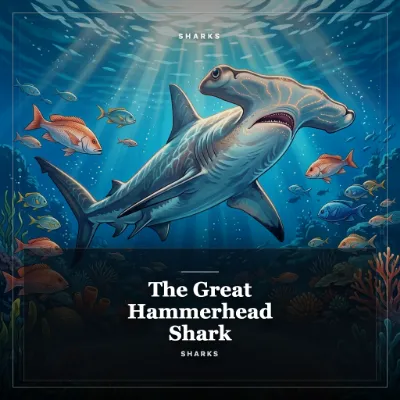
The Winghead Shark explores the unique marine biology of the shark with the widest head of all hammerheads. This audiobook introduces listeners to animal science and shark anatomy, explaining why this creature evolved its distinct head shape. It covers key scientific concepts including electroreception, predation, and migration patterns. Listeners will also learn about the shark's nursery habitat and the conservation efforts surrounding this species. Designed for kids and families, this guide provides a factual look at marine biology and the science behind one of the ocean's most unusual predators.
Why it's worth a listen
This audiobook brings marine biology to life by explaining how a uniquely shaped head helps this remarkable predator hunt and navigate. It offers families a fascinating look into ocean science, leaving listeners to wonder what other evolutionary secrets are waiting to be discovered beneath the waves.
What listeners will learn
Subjects: marine biology, sharks, conservation.
- cephalofoil
- electroreception
- stereo smell
- vision
- hydrodynamics
- evolution
- winghead
- shark
- widest
- head
Questions for after listening
- What is the most important idea from this book?
- Name one new word and explain what it means.
- Explain one idea from this book to a younger child.
Chapters
- The Shark With Wings For A Head
- A Blueprint in the Estuary
- The Architecture of the Cephalofoil
- An Ocean of Electric Fields
- Stereo Scent and the Geometry of Smell
- The Binocular Horizon
- Hydrodynamics and High-Speed Turns
- Life in the Shallows: Diet and Hunting
- The Cycle of the Nursery
- The Shadow of the Net
- Deep Time and the Hammerhead Lineage
- What the Extreme Teaches Us
Read a transcript preview
The Winghead Shark A deep ocean science audiobook for Emma ## 1. The Shark With Wings For A Head Emma, if you were to stand on the warm, humid shores of the Indo-West Pacific, where the green-brown waters of estuaries meet the open sea, you might catch a glimpse of one of the ocean's most astonishing masterpieces. This is not a creature of conventional beauty, nor is it a product of scientific fantasy. It is *Eusphyra blochii*, known more commonly, and poetically, as the winghead shark. To look at it is to confront a profound evolutionary puzzle. While most sharks possess a fusiform, streamlined body designed to cut through the water like a knife, the winghead shark carries atop its shoulders a structure that defies simple explanation: a head so wide, so flat, and so lateralized that it resembles the swept-back wings of an aircraft. In the study of natural sciences, we often search for the elegant economy of nature—the way form follows function with quiet efficiency. At first glance, the winghead shark seems to violate this principle of economy. Its head, known scientifically as a cephalofoil, is not a modest hammer shape like that of its cousin, the smooth hammerhead. Instead, it is an exaggeration, an anatomical exclamation point. The width of this head can equal nearly half the total length of the shark’s body. If we were to scale this proportion to a human being, it would be equivalent to a person possessing shoulders or a hat three feet wide. Yet, as you will discover as you journey deeper into the mechanics of the natural world, nature rarely wastes energy on mere decoration. Every millimeter of this extraordinary cartilage wing is a highly calibrated instrument. The winghead shark is not a giant of the deep; it typically reaches lengths of only one to one and a half meters. This modest size makes its massive head all the more striking. It is a specialized predator of shallow, coastal environments, a realm where visibility is low, competition is fierce, and survival demands sensory perfection. To understand the winghead shark is to understand how physical laws—specifically those of fluid dynamics, electromagnetism, and optics—shape the living clay of evolution. As we explore its anatomy, its sensory systems, and its ancient lineage, we will see that this shark is not an evolutionary eccentricity, but rather an exquisite solution to the challenges of life in the turbid waters of the tropical East. It is a living laboratory, offering us a window into the boldest experiments of natural selection. --- ## 2. A Blueprint in the Estuary To understand the winghead shark’s world, we must first immerse ourselves in the quiet complexity of its chosen habitat. *Eusphyra blochii* does not patrol the clear, sun-drenched coral reefs of the open ocean, nor does it descend into the abyssal plains where light never reaches. Instead, it is a creature of the margins. It dwells in the shallow, coastal waters, muddy bays, and brackish estuaries that stretch from the Persian Gulf, across the coastlines of India and Southeast Asia, and down to the northern shores of Australia. This is an environment of constant transition. Here, major river systems empty their sediment-laden waters into the sea, creating a dynamic zone where fresh water and salt water mix. The water in these estuaries is highly turbid, a term scientists use to describe water that is cloudy, thick with suspended particles of silt, clay, and decaying organic matter. In these environments, sunlight is scattered and absorbed within the first few meters of the surface. For a human swimmer, visibility would be reduced to a few inches; for most marine organisms, reliance on vision alone would be a recipe for starvation. Yet, these murky shallows are among the most biologically productive zones on Earth. The constant influx of nutrients from the land fuels a dense food web, from microscopic plankton to teeming schools of small fish, prawns, and cephalopods. For a predator capable of navigating this opaque world, the rewards are immense. The winghead shark has adapted specifically to thrive in this high-nutrient, low-visibility theater. The physical challenges of the estuary have directly driven the evolution of the shark's unusual body plan.…
Editorial review
Quality reviewed · 96/100 on . Certificate EL-1D91-1DC5 is bound to the exact narrated script.
The review checks factual care, audience fit, teaching quality, structure, tone and source honesty. Read the editorial standards.
Published 2026-06-20 · Updated