- Who is it for?
- Ages 8–13
- How long is it?
- 40 min
- What does it include?
- Synced read-along and a quiz
- What does it cost?
- Free — no sign-up required
About this audiobook
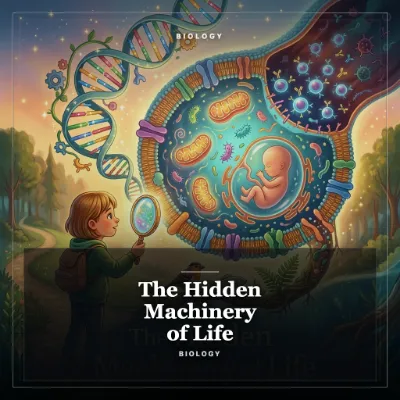
Why Are Humans Symmetrical? explores the hidden geometry of the human body, focusing on why we have two of some anatomical features and only one of others. This biology audiobook introduces young listeners to the fundamental concepts of human development, anatomy, and evolution. It explains how our body plan is structured around symmetry, examining the relationship between our left and right sides. Listeners will learn about the science behind how the human body forms, how evolution shapes our physical features, and what our anatomical structure reveals about human biology.
Why it's worth a listen
This engaging audio guide makes complex biological concepts easy to understand by transforming the way families look at their own bodies. Listeners will gain a new appreciation for the evolutionary design that shapes us from head to toe, leaving everyone wondering what other secrets our anatomy might be hiding.
What listeners will learn
Subjects: biology, human body, evolution.
- symmetry
- body plan
- left and right
- development
- evolution
- anatomy
- humans
- symmetrical
- have
- some
Questions for after listening
- What is the most important idea from this book?
- Name one new word and explain what it means.
- Explain one idea from this book to a younger child.
Chapters
- The Almost-Mirror Body
- The Architecture of Motion
- The Three Great Coordinates
- The Language of the Embryo
- The Master Sculptors: Hox Genes
- The Whispering Cilia
- The Asymmetric Interior
- Developmental Noise and the Imperfect Line
- The Geometry of the Face
- Across the Tree of Life
- The Mathematics of Emergence
- The Horizon of Natural Science
Read a transcript preview
Why Are Humans Symmetrical? A deep biology audiobook for Emma ## 1. The Almost-Mirror Body Emma, if you stand before a tall mirror and study your reflection, your mind will naturally perform an act of instant, unconscious mathematics. You will trace a line down the center of your forehead, along the bridge of your nose, through the cleft of your lip, and down the center of your chest. To your eye, the left side of your body appears to be a perfect, faithful translation of the right, cast across an invisible axis. This is bilateral symmetry, a geometric design so deeply woven into our perception of life that we often mistake it for an absolute law of nature. We look at a butterfly with its painted wings, a soaring falcon, or a hunting tiger, and we see two halves of a single, exquisite portrait. In the language you love so much, you might call this a biological rhyme, a repeating stanza where the left and right sides answer one another in perfect harmony. But if you look closer, the rhyme begins to reveal its subtle, necessary imperfections. The two halves of your face are not identical twins; they are more like close cousins. One eye may sit a millimeter higher than the other; the curve of one nostril may be slightly more pronounced; the arch of your left eyebrow may speak a different expressive language than your right. If you were to take a photograph of your face, cut it down the center, and create two perfectly symmetrical portraits—one made entirely of your left side mirrored, and one of your right—you would find yourself staring at two strangers. They would look uncanny, cold, and strangely artificial. This is because biological symmetry is never a sterile, mathematical mirror. It is a living, breathing pattern, a dynamic balance that is constantly negotiated during the silent, dark journey of your development before you were born. To understand why we are symmetrical on the outside, we must first confront the deep mystery of why we are not symmetrical on the inside. Beneath the skin, the illusion of the mirror vanishes entirely. Your heart does not sit in the dead center of your chest; it is tilted, its powerful left ventricle leaning toward your left side, pumping life through an asymmetric arch of the aorta. Your liver, a heavy and complex chemical factory, sits largely on the right side of your abdomen, balanced on the left by the dark, curved pouch of your stomach and the delicate, elongated finger of your pancreas. Your lungs are not identical partners; the right lung has three distinct lobes, while the left has only two, leaving a carved-out space, the cardiac notch, to accommodate the beating presence of your heart. Your intestines wind through your abdomen in a highly coordinated, asymmetric spiral, always turning in the same direction, a path determined by a ancient molecular compass. How does a single, fertilized egg cell, which begins as a simple, symmetric sphere, grow into a creature that is so beautifully ordered on the outside, yet so purposefully lopsided on the inside? How does the developing embryo know its left from its right, its front from its back, and its head from its tail? The answer is not found in a rigid blueprint drawn by a designer who folded a page in half and copied the pattern. Instead, it is found in a magnificent, unfolding narrative of evolutionary history, genetic cascades, microscopic fluid dynamics, and the physical laws of our universe. It is a story that bridges the grand scale of deep time with the microscopic whisper of molecules inside a single cell. ## 2. The Architecture of Motion To find the origin of your symmetrical frame, Emma, we must travel backward through the deep library of geological time, far beyond the age of the dinosaurs, beyond even the first forests, to a world covered entirely by a vast, primeval ocean. More than five hundred million years ago, during a period of intense evolutionary creativity known as the Cambrian Explosion, the ancestors of almost all modern animals made a fundamental, historic choice. Up until this point in the history of life, the…
Editorial review
Quality reviewed · 94/100 on . Certificate EL-EDA1-DE41 is bound to the exact narrated script.
The review checks factual care, audience fit, teaching quality, structure, tone and source honesty. Read the editorial standards.
Published 2026-06-20 · Updated