- Who is it for?
- Ages 8–14
- How long is it?
- 48 min
- What does it include?
- Synced read-along and a quiz
- What does it cost?
- Free — no sign-up required
About this audiobook
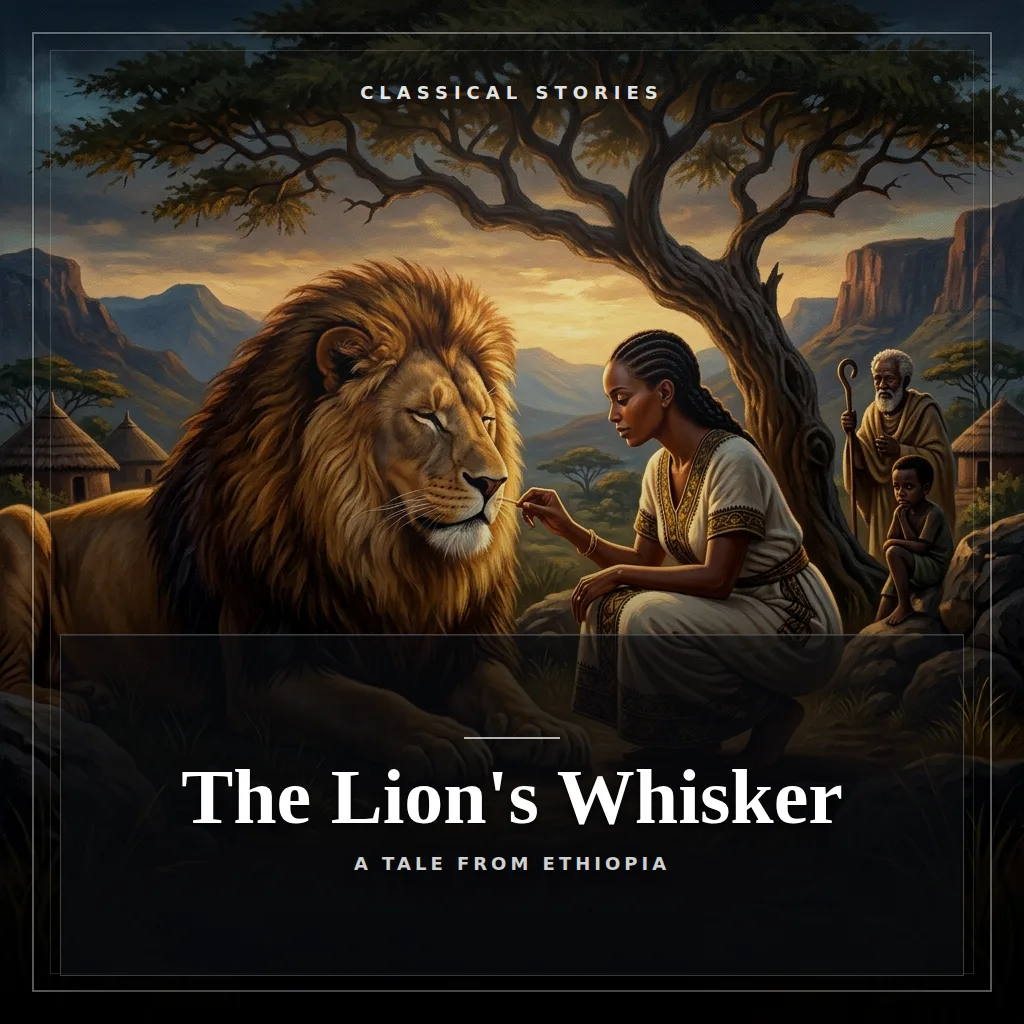
A newly married woman loves her husband's young son, but the boy, still grieving his mother, will not accept her — he refuses her food, her words, her kindness. In despair she goes to the village healer and begs for a charm to win his love. The healer says he can make one, but she must first bring him a whisker from a living lion. She is terrified, but determined. Each day she carries meat to the edge where a lion lives, leaving it and retreating; each day she comes a little closer, until weeks later the lion eats from her hand and lets her sit beside it — and she gently plucks a single whisker. When she brings it in triumph, the healer smiles and throws it into the fire: the medicine, he says, was never the whisker. It was the patience.
Why it's worth a listen
A young woman despairs that her grieving stepson will never warm to her, and asks a wise healer for a potion to win his heart. The healer agrees — if she can bring back a single whisker plucked from a living lion. Her long, patient courtship of the most dangerous animal in the country teaches her the very thing she needed all along. A quietly profound Ethiopian tale about patience and love.
What listeners will learn
Subjects: world stories, literature, cultural literacy.
- character
- setting
- conflict
- choice
- consequence
- theme
- retelling
- lion
- whisker
- classical
Questions for after listening
- Retell the central conflict in order.
- Name one important choice and what happened because of it.
- How did the setting or tradition shape the story?
A question to keep
If you can tame a lion with patience, what could patience do for the people you love?
Chapters
- The Cold Hearth
- The Healer's Chamber
- The Edge of the Forest
- The Breath of the Beast
- Into the Fire
- A Question to Keep
Read a transcript preview
High on the green plateaus of Ethiopia, where the earth rises up to meet a sky of brilliant, endless blue. There is a land of ancient mountains, deep, whispering valleys, and soil the color of rich, dark chocolate. This is the Horn of Africa, a place where the wind carries the scent of wild sage and roasting coffee beans, and where stories have been kept alive for thousands of years, passed down like precious heirlooms from one generation to the next. Some say these stories are carved into the very rocks of the Highlands, waiting for someone with a quiet heart to come and listen. This is one of those tales, told in many ways across the centuries, but always carrying the same gentle truth at its center. In a small village nestled at the foot of these great mountains, lived a young woman named Fanaye. She was a person of quiet grace, with eyes that saw the beauty in small things, and hands that were never idle. Not long ago, Fanaye had married a good man named Tilahun, a farmer who worked the terraced fields of teff and barley. Tilahun was strong and kind, and when he looked at Fanaye, his face filled with a warmth that could rival the morning sun. Fanaye loved him dearly, and she had entered her new home with a heart full of hope, ready to build a life of shared laughter, warm meals, and abundant love. But a house is not made of wood and stone alone. It is made of the spirits of those who dwell within it. And in Tilahun's house, there was a shadow. Tilahun had a young son named Dawit, who was barely nine years old. Dawit was a boy with a face like a carved cedar branch, beautiful, but set in lines of deep, unyielding sorrow. Only a year before, Dawit's mother had passed away, leaving a void in the boy's life that felt as vast and cold as the mountain gorges in the dead of winter. To Dawit, his mother had been the sun, the moon, and the stars. She had been the one who sang him to sleep, who wove stories out of the shapes of the clouds, and who held his hand when the thunder rolled across the plateau. When she died, a part of Dawit seemed to go with her. He did not cry in front of others. Instead, he wrapped his grief around himself like a heavy woolen blanket, shutting out the rest of the world. When Fanaye first arrived, she believed she could heal this wound. She believed that with enough warmth, she could melt the ice in the boy's heart. She set to work with a gentle, eager energy. She swept the earthen floors until they were spotless. She polished the clay cooking pots until they gleamed in the firelight. Most of all, she poured her heart into the food she prepared. She spent hours roasting spices, grinding them with a heavy stone pestle to make the rich red pepper paste called berbere. She baked fresh, spongy injera bread, spreading it out in wide, perfect circles on the clay griddle, and simmered savory stews of lentils and chicken, hoping the delicious aromas would draw the boy out of his shell. But when dinner was served, Dawit would sit as far from Fanaye as the small room allowed. He would look down at his hands, his face blank and distant. "Come, Dawit," Fanaye would say, her voice as soft as a lullaby. "Eat. I made the stew just the way your father says you like it. It has the sweet onions and the rich cardamoms. It will make you strong." Dawit would not look at her. He would not touch the food. If his father pressed him, the boy would take a single tiny bite, chew it slowly as if it were sand, and then slide his plate away. "I am not hungry," he would whisper to the floor. "Dawit," Tilahun would sigh, his heart torn between his love for his new wife and his deep grief for his son. "You must eat. Fanaye has worked all day to prepare this for…
Editorial review
Quality reviewed · 95/100 on . Certificate EL-3575-6762 is bound to the exact narrated script.
The review checks factual care, audience fit, teaching quality, structure, tone and source honesty. Read the editorial standards.
Published 2026-07-11 · Updated