- Who is it for?
- Ages 8–14
- How long is it?
- 49 min
- What does it include?
- Synced read-along and a quiz
- What does it cost?
- Free — no sign-up required
About this audiobook
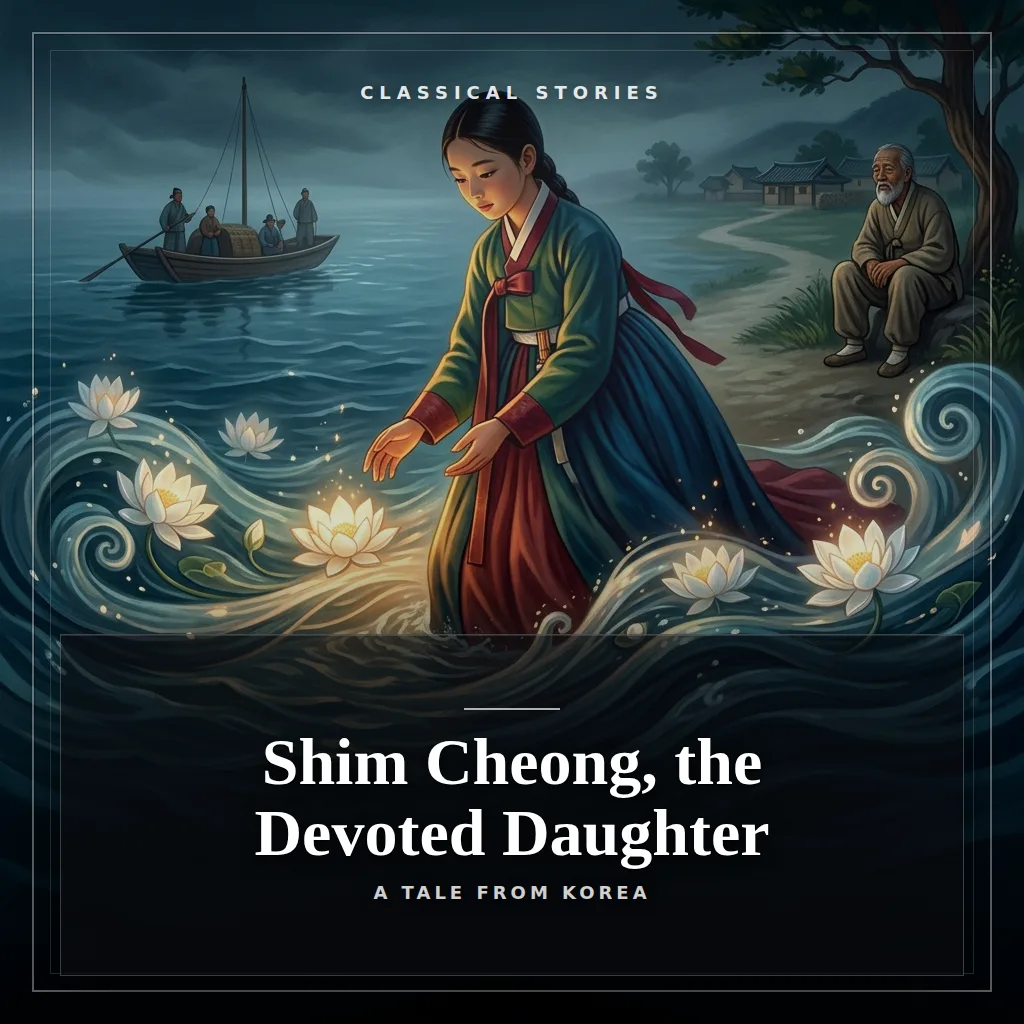
Shim Cheong is raised by her blind father alone, and cares for him with all her heart. When a monk tells her father that an offering of three hundred sacks of rice to the temple would restore his sight, the old man rashly pledges it — a fortune they could never pay. To keep his promise and save his eyes, Shim Cheong sells herself to sailors who need a maiden to sacrifice to the dragon-king so their ship may pass the deadly waters. She leaps into the sea — but her devotion so moves the dragon-king that instead of death she is honored, sent back to the surface inside a great lotus flower, discovered by the king of the land, and made his queen. And she has one wish: to find her father, and finally let him see her.
Why it's worth a listen
A blind widower's devoted daughter learns that a fortune in rice offered to the temple might restore her father's sight — a fortune far beyond them — and makes a heartbreaking bargain with sea-merchants who need a sacrifice for the dragon-king of the deep. Korea's most beloved tale of devotion, and the astonishing turn the sea gives it.
What listeners will learn
Subjects: world stories, literature, cultural literacy.
- character
- setting
- conflict
- choice
- consequence
- theme
- retelling
- shim
- cheong
- devoted
Questions for after listening
- Retell the central conflict in order.
- Name one important choice and what happened because of it.
- How did the setting or tradition shape the story?
A question to keep
How far would you go for someone you love — and what if the sacrifice is not the end of the story?
Chapters
- The Sound of the Wooden Fish
- A Promise Built of Rice and Stars
- The Price of the Sea
- Into the Indigo Waves
- The Palace of the Dragon King
- The Great Feast of the Blind
- A Question to Keep
Read a transcript preview
If you were to stand on the high rocky cliffs of the Korean peninsula many hundreds of years ago, you might hear two sounds rising above the endless rhythm of the ocean waves. The first sound is the steady, resonant thump clack of a barrel drum. This is the heartbeat of Pansori, a traditional way of telling stories in Korea. In the old days, a single singer would stand before a crowd for hours, accompanied only by that drum, pouring their entire soul into song. They would mimic the wind, the crying of a child, the crashing of the sea, and the quiet sigh of a parent. The Pansori singers knew that a great story is not just something you hear. It is something that vibrates in your chest. The second sound you might hear, if you walked down from the cliffs and into the quiet, mist-shrouded valleys, is the gentle tap, tap, tap of a wooden staff on the dirt road. This was the sound of Shim Hak-gyu, a man who lived in a world of perpetual twilight. Shim Hak-gyu was blind. He had not always been so, but the light had faded from his eyes years ago, leaving him with only the memories of colors. The bright red of autumn maples, the deep blue of the sky over the East Sea, and the warm, soft face of his beloved wife. Sadly, his wife had passed away shortly after giving birth to their daughter, leaving the blind man alone in a small, drafty cottage at the edge of a quiet village. He named his daughter Shim Chong. Chong means clear water, and no name could have been more fitting. When Chong was just a tiny baby, her father did not know how he would keep her alive. He had no money, no land, and no eyes to guide his hands. But he had a heart filled with an ocean of love. Every morning, he would tie the tiny baby to his back with a strip of faded cloth and step out into the village. Tap, tap, tap went his staff. He would knock on the gates of the wealthier homes, bowing low, and ask if any of the nursing mothers could spare a little milk for his motherless child. The villagers, moved by the sight of the blind father cradling his baby in the cold wind, were kind. One mother would feed Chong in the morning. Another would offer a warm bowl of barley water in the afternoon. And so, nurtured by the collective kindness of the village and the fierce protective love of her father, Shim Chong grew. As soon as her little legs were strong enough to carry her, the roles in the cottage began to shift. Chong became her father's eyes. "Father, watch your step," she would say, her hand warm and small inside his rough, weathered palm. "There is a patch of slick ice ahead, just by the old pine tree." "Ah, thank you, my little flower," he would reply, his face lighting up with a smile that chased away the shadows of his blindness. By the time Chong was 15, she had grown into a young woman of remarkable grace and beauty. But it was her heart that the villagers spoke of most. She did not spend her days playing with the other children or dreaming of fine silk dresses. Instead, she worked from dawn until dusk. She spun thread for the weavers, washed clothes in the icy mountain streams until her fingers were red and numb, and gathered wild herbs from the forest slopes. Every copper coin she earned was spent on soft rice and warm charcoal for her father. When she returned home in the evening, she would cook their simple meal, making sure her father received the largest portion of rice, while she took only the thin broth at the bottom of the pot. "Chong-ah," her father would say, touching her face with trembling fingers. "Have you eaten? You feel so thin. You must not starve yourself for an old, useless man." "I have eaten until I am full, father," she would lie gently, placing a warm bowl in his hands.…
Editorial review
Quality reviewed · 88/100 on . Certificate EL-FE8A-134E is bound to the exact narrated script.
The review checks factual care, audience fit, teaching quality, structure, tone and source honesty. Read the editorial standards.
Published 2026-07-11 · Updated