- Who is it for?
- Ages 8–14
- How long is it?
- 44 min
- What does it include?
- Synced read-along and a quiz
- What does it cost?
- Free — no sign-up required
About this audiobook
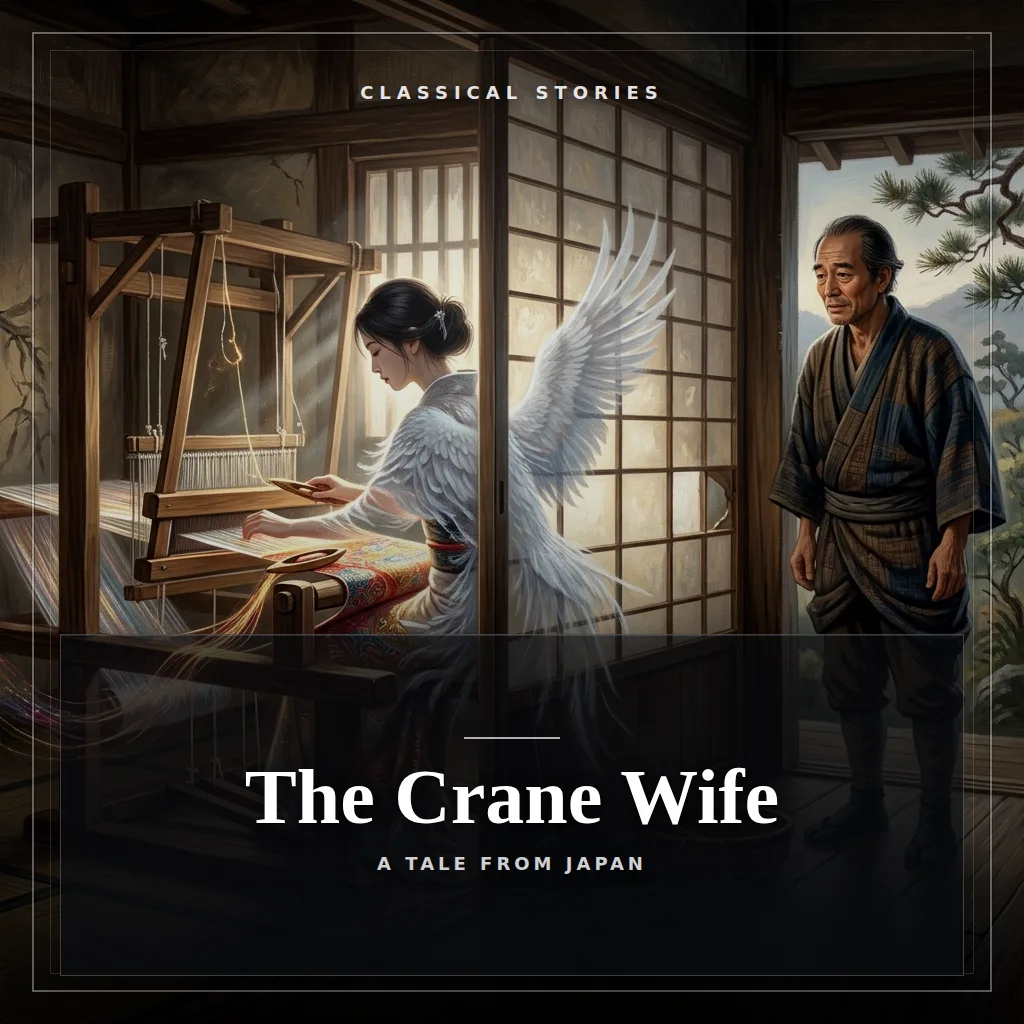
A kind, poor man frees a crane caught in a snare and lets it fly away. That evening a young woman arrives at his lonely house in the snow and, with quiet grace, becomes his wife. She offers to weave, but makes him promise never to watch her at the loom. The cloth she produces is so exquisite it sells for a fortune, and their life eases — but each weaving leaves her thinner and paler, and the more the cloth earns, the more it is wanted. At last, driven by curiosity and by others' greed for more, the husband slides open the forbidden door — and sees not his wife but a crane, plucking its own feathers to weave, nearly bare. The secret seen, the spell breaks: the crane, revealed, must fly away forever.
Why it's worth a listen
A poor man frees a wounded crane from a trap; that night a gentle woman appears at his door and becomes his wife, and weaves cloth of impossible beauty on the one condition that he never watch her work. Their fortune grows — and so does his curiosity. One of Japan's most beloved and heartbreaking tales, about gratitude, greed, and the door we are asked not to open.
What listeners will learn
Subjects: world stories, literature, cultural literacy.
- character
- setting
- conflict
- choice
- consequence
- theme
- retelling
- crane
- wife
- classical
Questions for after listening
- Retell the central conflict in order.
- Name one important choice and what happened because of it.
- How did the setting or tradition shape the story?
A question to keep
Can love survive the need to know a secret it was asked to leave alone?
Chapters
- The Feather in the Snow
- The Knock at the Door
- The Secret of the Loom
- The Shadow of Gold
- The Sliding Door
- A Question to Keep
Read a transcript preview
The wind that sweeps down from the northern mountains of Japan in the deep of winter does not merely blow. It speaks. It whispers through the dark pines. It rattles the dry bamboo, and it sighs across the heavy drifts of snow that bury the valleys in a silent white sleep. If you were to travel back in time, many hundreds of years to a small, lonely valley in that beautiful country, you would find a tiny wooden hut with a thatched roof, nearly swallowed by the snow. In this hut lived a young man named Yohei. Yohei was a simple man and very poor. He had no grand titles, no chest of gold, and no family to keep him company. His days were spent in the forest, gathering fallen branches to sell as firewood in the distant town, or clearing the heavy snow from his roof so the beams would not break under the weight. His hands were rough and calloused from hard work, and his face was lined by the cold wind. But his heart was as soft and gentle as the first snowfall of spring. He was the kind of man who would step out of his way to avoid crushing an ant, and who always left a few grains of his meager supper on the window sill for the winter birds. Now, the story we are sharing tonight is one that has been told in Japan for generations, passed down from grandmothers to children as they huddled around the warm charcoal fires of the Irori hearth. Like all great stories, it has been told in many different ways, with different names and different endings, but the heart of the tale remains unchanged. It is a story about a quiet kind of magic, the weight of a promise, and the fragile nature of trust. On one particular afternoon, the cold was so sharp, it felt like needles against Yohei's cheeks. The sky was the color of bruised iron, and the sun was nothing more than a pale frozen coin sliding behind the peaks. Yohei was walking home along the edge of the great marsh, his bundle of firewood strapped tightly to his back. His feet sank deep into the snow with every step, making a slow rhythmic sound. Shuck, shuck, shuck. Suddenly, a sound broke the winter silence. It was not the wind, and it was not the creak of the trees. It was a sharp, high cry, a sound of terrible pain and distress. Yohei stopped. He tilted his head, listening intently. The sound came again, a desperate fluttering of wings and a low mournful trumpet. Yohei set his bundle of wood down in the snow and hurried toward the marsh, his boots breaking through the icy crust. There, in the middle of a clearing of frozen reeds, he saw a magnificent creature. It was a red-crowned crane, one of the most sacred and beautiful birds in all of Japan. It stood nearly as tall as Yohei himself, with feathers as white as fresh cream, a long elegant neck of midnight black, and a crown of brilliant crimson on its head, like a drop of fresh blood on the snow. But the great bird was not flying. It was trapped. A hunter's snare of thick rusted wire had coiled around its slender leg, cutting into the flesh. The crane was thrashing wildly, its great wings beating the air, throwing up clouds of powdery snow. But the more it struggled, the tighter the wire bit into its leg. Its feathers were ruffled and soiled, and its eyes were wide with terror. "Oh, gentle one," Yohei whispered, stepping forward slowly. "Be still. Please do not be afraid." At the sound of his voice, the crane froze. It turned its long sharp beak toward him, its dark liquid eye staring into his own. Yohei could see the bird's chest heaving with exhaustion. It had no strength left to fight. Yohei knelt in the snow beside the great bird. He knew that a crane's beak could be a dangerous weapon, sharp enough to pierce a man's hand, but he felt no fear. He spoke in a low, soothing hum, the…
Editorial review
Quality reviewed · 94/100 on . Certificate EL-4FAA-9853 is bound to the exact narrated script.
The review checks factual care, audience fit, teaching quality, structure, tone and source honesty. Read the editorial standards.
Published 2026-07-11 · Updated