- Who is it for?
- Ages 8–14
- How long is it?
- 40 min
- What does it include?
- Synced read-along and a quiz
- What does it cost?
- Free — no sign-up required
About this audiobook
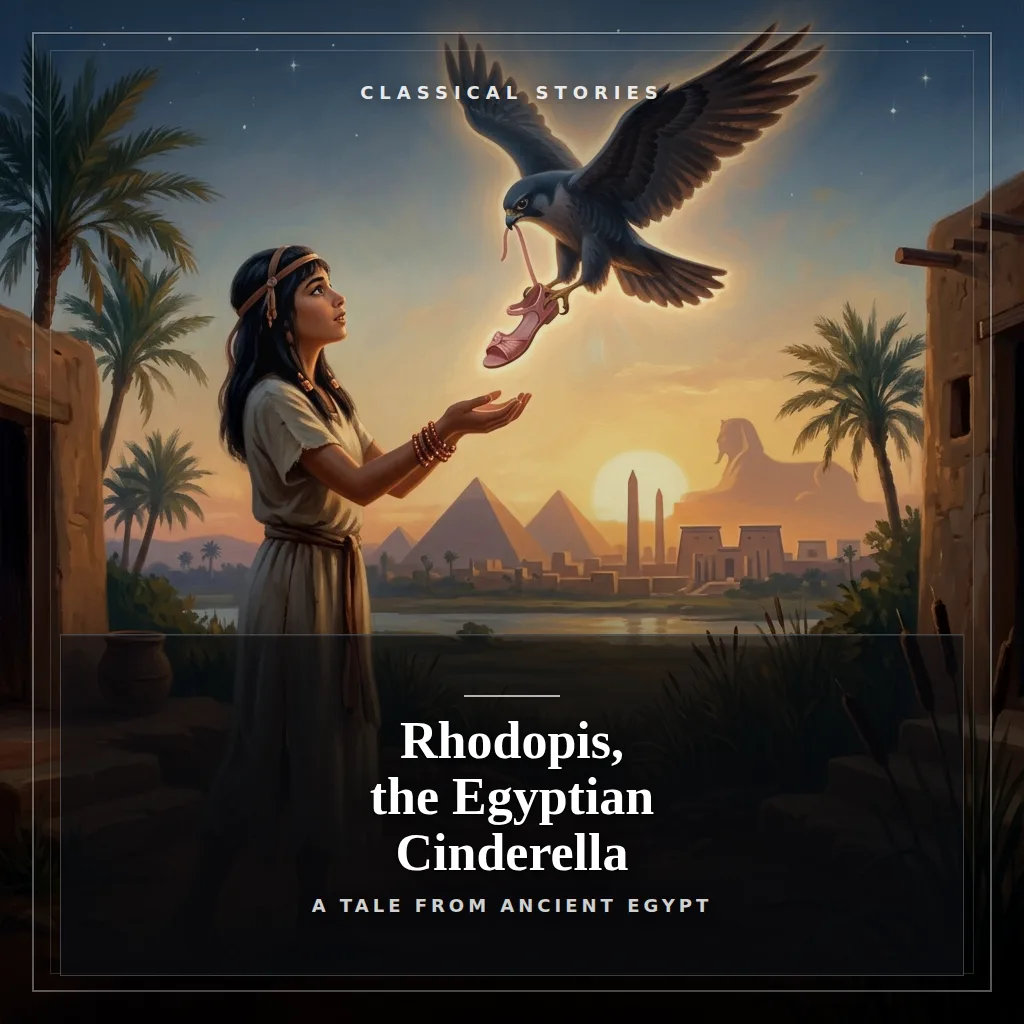
Rhodopis is a Greek girl sold into servitude in Egypt, teased by the other servant girls for her fair skin and quiet ways, with only the animals for friends. Her one treasure is a pair of rose-red slippers her kind master gives her. One day, as she washes by the Nile, a falcon — sacred to the sky-god Horus — swoops down, snatches a single slipper, and carries it off. It drops the slipper into the lap of the Pharaoh at his court, and he takes it as a sign from the gods: he will marry the woman whose foot it fits. He searches all Egypt by barge, and comes at last to the riverbank where a mocked servant girl steps forward, holding the slipper's twin.
Why it's worth a listen
Two thousand years before the fairy tale you know, ancient Egypt told of a servant girl mocked for her looks, a pair of rose-red slippers, and a falcon that snatches one and drops it in the lap of the Pharaoh himself. The original Cinderella — no fairy godmother, just a bird, a slipper, and a king who decides to go looking.
What listeners will learn
Subjects: world stories, literature, cultural literacy.
- character
- setting
- conflict
- choice
- consequence
- theme
- retelling
- rhodopis
- egyptian
- cinderella
Questions for after listening
- Retell the central conflict in order.
- Name one important choice and what happened because of it.
- How did the setting or tradition shape the story?
A question to keep
Is it luck, kindness, or something in a person that fortune finally notices?
Chapters
- The Girl from the Northern Sea
- The Gift of Rose-Red Leather
- The Day of the Great Festival
- The Shadow of Horus
- The Sign in the Pharaoh's Lap
- The Footprint in the River Silt
- A Question to Keep
Read a transcript preview
Long before the world knew of glass slippers, pumpkin coaches or fairy godmothers, there was a girl, a river, and a golden bird. Our story begins more than 2,000 years ago in the land of Egypt, a place of towering stone temples, shimmering heat, and a great life-giving river called the Nile. The ancient Egyptians called their land Kemet, the black land, because of the rich dark soil the river left behind each year after the floods. It was a land of deep magic, where the sun was a god who sailed across the sky in a golden boat, and where the movements of birds in the air were read like letters from the heavens. This particular story is what we call a Greco-Egyptian tale. It was first recorded by an ancient Greek geographer named Strabo, who traveled up the Nile and listened to the stories the people whispered in the shade of the willow trees. It is, perhaps, the oldest version of the Cinderella story ever told, and it begins not with a wave of a magic wand, but with a young girl who was very far from home. Her name was Rhodopis. In her native Greece, her name meant rosy-cheeked, a reminder of the cool mountain breezes of her childhood. But Rhodopis was no longer in Greece. When she was still very young, she had been captured by pirates, a common and terrible danger in those ancient times, and brought across the wine dark Mediterranean Sea to be sold into servitude. She had ended up in the northern Delta of Egypt, in a bustling multicultural city called Naucratis, where Greek merchants and Egyptian crafts people lived and worked side by side. Rhodopis lived in the household of a wealthy master. It was a beautiful estate with white plaster walls that reflected the fierce Egyptian sun, and a garden filled with sweet smelling jasmine and pomegranate trees. But for Rhodopis, it was a place of quiet loneliness. She looked entirely different from everyone else in the household. The other servant girls had skin the color of warm honey, sleek black hair that fell in heavy braids, and dark almond-shaped eyes. Rhodopis, on the other hand, had skin so pale that the hot Egyptian sun burned it red if she stood in the light for too long. Her hair was a crown of wild, golden red curls that refused to lie flat, and her eyes were the green of a shallow sea. Because she looked so different, and because she had been born in a foreign land, the other servant girls did not understand her. And as people sometimes do when they encounter someone they do not understand, they chose to be unkind. "Look at the ghost girl," they would whisper, laughing behind their hands as they ground the grain on flat stones. "She looks like she was carved from salt. If she stays in the rain, she might melt away entirely." They called her the pomegranate because her fair skin flushed so easily in the heat. They made sure she received the heaviest chores, scrubbing the stone floors, carrying the heavy water jars from the river, and washing the linen sheets until her hands were raw and chapped. Rhodopis did not fight back. She was a quiet girl, dignified and gentle, and she preferred to keep her thoughts to herself. When the teasing became too loud, she would slip away to the edge of the great river. The Nile was her sanctuary. To Rhodopis, the river was not just water. It was a living, breathing companion. She would sit in the shade of the tall papyrus reeds, watching the green and bronze dragonflies dart across the surface. She made friends with the creatures that lived there. There was a blue kingfisher that would sit on a branch near her, tilting its head as if listening to her secrets. There were the small gray river birds that would hop right onto her knee to peck at the breadcrumbs she saved from her meager meals. Most surprising of all, there was a great lazy hippopotamus that wallowed in the mud flats nearby. The other girls screamed and ran when they saw…
Editorial review
Quality reviewed · 96/100 on . Certificate EL-A230-B6D5 is bound to the exact narrated script.
The review checks factual care, audience fit, teaching quality, structure, tone and source honesty. Read the editorial standards.
Published 2026-07-11 · Updated