- Who is it for?
- Ages 8–14
- How long is it?
- 41 min
- What does it include?
- Synced read-along and a quiz
- What does it cost?
- Free — no sign-up required
About this audiobook
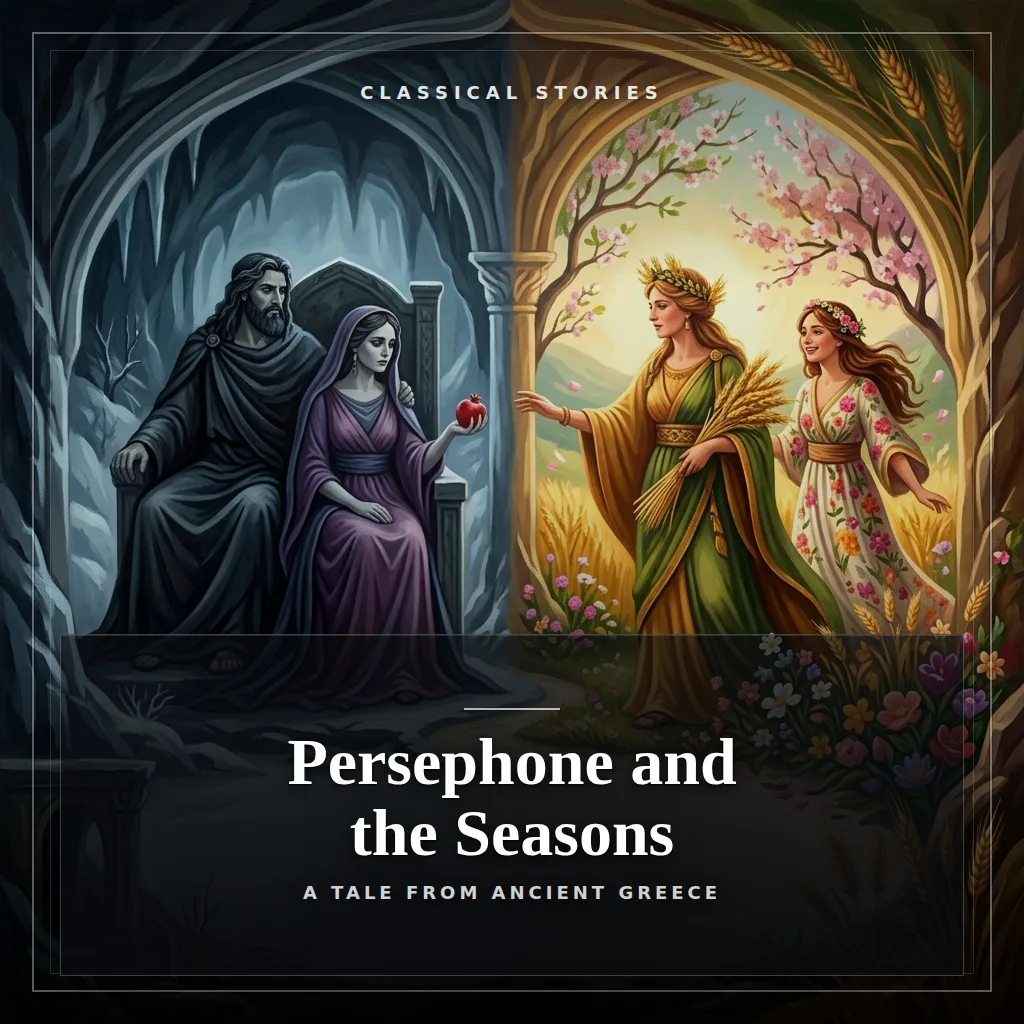
Persephone, daughter of Demeter the harvest goddess, is gathering flowers when the earth opens and Hades, lord of the dead, carries her down to be his queen. Demeter searches the whole world for her child, and in her grief the fields stop growing, the crops die, and the first winter falls. Zeus commands Persephone returned — but she has eaten a few seeds of a pomegranate in the underworld, and whoever eats the food of the dead must return to it. So the year is divided: the months she spends below, the world mourns; the months she rises, spring comes running back.
Why it's worth a listen
The Greek answer to why winter exists: a daughter carried into the underworld, a mother whose grief freezes the whole earth, and six small pomegranate seeds that decide the shape of every year forever after. A myth that turns the calendar itself into a story about letting go and coming back.
What listeners will learn
Subjects: world stories, literature, cultural literacy.
- character
- setting
- conflict
- choice
- consequence
- theme
- retelling
- persephone
- seasons
- classical
Questions for after listening
- Retell the central conflict in order.
- Name one important choice and what happened because of it.
- How did the setting or tradition shape the story?
A question to keep
Can something be both a loss and a return — and is that why the seasons turn?
Chapters
- Introduction
- The Meadow and the Chariot
- The Mother's Search
- The First Winter
- The Messenger in the Dark
- The Pomegranate Seeds
- The Great Bargain
- A Question to Keep
Read a transcript preview
Number 34. Persephone and the seasons. Long ago, before the world had ever heard the whistle of a cold wind or seen the leaves of the oak trees turn to gold and drift to the earth, the world was always warm. There was no winter, there was no autumn. If you had lived in those days, you would have known only an endless golden summer. The branches of the apple trees were always heavy with sweet red fruit. The fields of wheat were always thick and yellow, waving in a gentle breeze, and flowers of every color imaginable bloomed day after day, never drooping, never dying. This was the world of ancient Greece, a land of high rocky mountains, deep blue seas, and olive groves that stretched as far as the eye could see. The people who lived there told many stories to explain the wonders of the world around them. They believed the earth was watched over by powerful immortal gods, who lived on the cloud-shrouded peak of Mount Olympus. And among all these stories, there is one that has been told for thousands of years in many different ways, about a mother, a daughter, and the secret of how the seasons were born. At the very heart of this endless summer, lived Demeter, the goddess of the harvest. She was one of the oldest and most powerful of the gods, and she loved the earth with a fierce protective warmth. It was Demeter who taught humans how to plant seeds in the dark soil, how to tend the young green shoots, and how to reap the golden grain when it was ripe. Wherever Demeter walked, the earth came alive. Wild flowers sprang up in her footprints, and the orchards bowed their branches to offer her their finest fruits. But as much as Demeter loved the earth, she loved her daughter Persephone a thousand times more. Persephone was the goddess of spring growth. She was young, full of laughter, and her heart was as bright as the morning sun. Wherever Persephone went, joy followed. She spent her days running through the meadows, singing with the nymphs of the springs and forests, and watching the buds open at the touch of her fingers. To Demeter, Persephone was the light of her life. As long as they were together, the world remained in its perfect, unchanging summer. One bright morning, Persephone went down to a wide grassy meadow near the sea. The air was sweet with the scent of wild thyme, and the sky was a brilliant cloudless blue. She was accompanied by her friends, the sea nymphs, and together they laughed and ran, gathering flowers to weave into crowns for their hair. They picked purple violets, sweet smelling lilies, and bright red roses, piling them into baskets woven of reeds. As Persephone wandered a little further from the others, searching for the prettiest blossoms, she noticed a flower she had never seen before. It grew near the edge of a deep rocky ravine, standing tall and proud. It was a narcissus, but it was unlike any ordinary flower. It had a hundred blossoms growing from a single stem, and its petals shown like polished silver in the sunlight. Its scent was so sweet and intoxicating that it seemed to fill the entire valley, making the very air shimmer with magic. Intrigued, Persephone stepped closer. She leaned down, her heart beating with wonder, and reached out her hand to pluck the beautiful flower. But the moment her fingers touched the stem, a strange low rumble echoed through the earth. It was not the sound of thunder from the sky, but a deep groaning vibration from far beneath her feet. The birds in the trees stopped singing. The wind died down, leaving the air heavy and still. Persephone froze, her hand still hovering over the flower. Suddenly, with a sound like a tearing sheet of iron, the earth split open. A great yawning chasm appeared right before her eyes, swallowing the silver flower and sending clouds of dark dust swirling into the bright morning air. Out of the black depths of the chasm, rose a magnificent chariot. It was made of solid…
Published 2026-07-11 · Updated