- Who is it for?
- Ages 8–14
- How long is it?
- 57 min
- What does it include?
- Synced read-along and a quiz
- What does it cost?
- Free — no sign-up required
About this audiobook
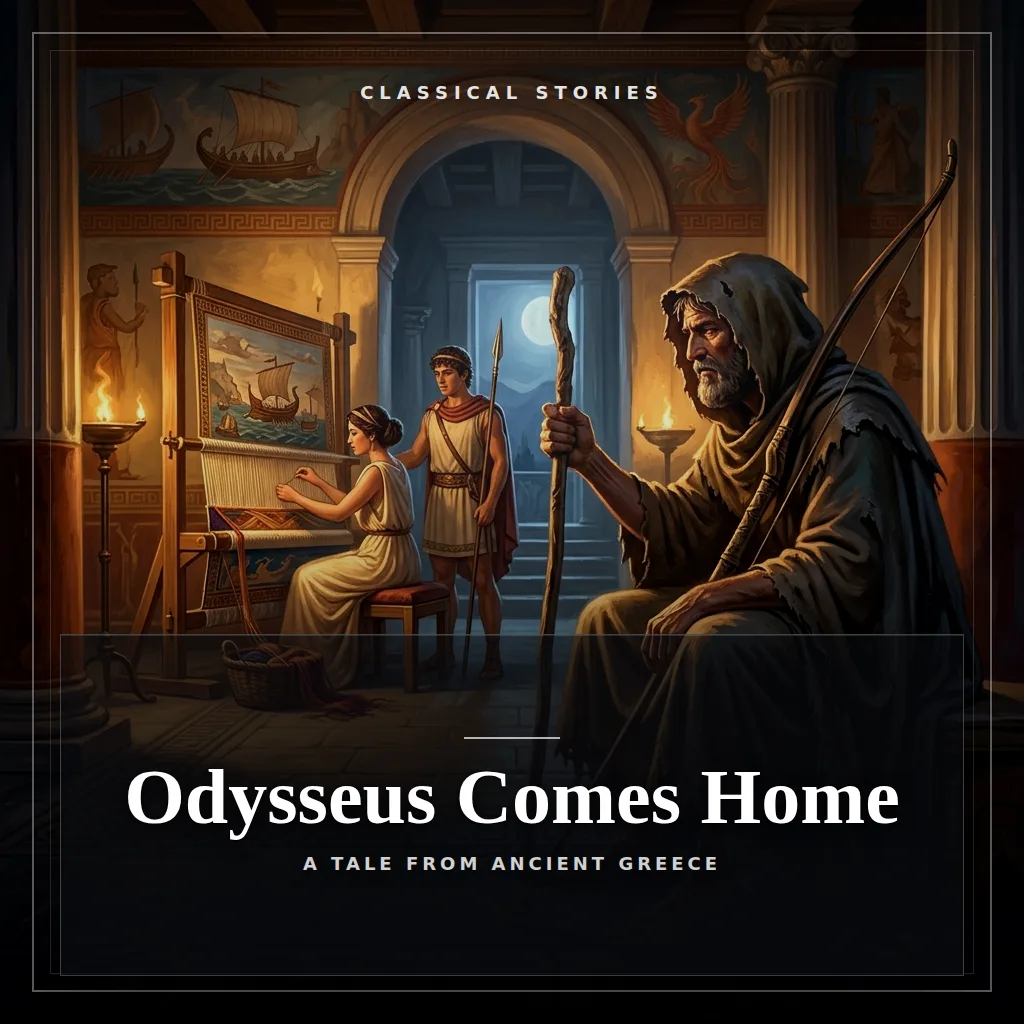
Twenty years after sailing to Troy, Odysseus reaches Ithaca at last — but his palace is full of arrogant suitors eating his wealth and pressing his wife Penelope to remarry. Athena disguises him as a ragged beggar so he can see who has stayed loyal and who has not. Only his old dog and his childhood nurse know him. Penelope, clever as her husband, sets a contest: whoever can string Odysseus's great bow and shoot through twelve axe-heads will win her hand — a feat she knows only one man alive can perform.
Why it's worth a listen
The end of the greatest journey in literature is not a battle at sea but a homecoming in disguise: a king walks into his own house dressed as a beggar, insulted at his own door, watched by a wife who has waited twenty years and a dog who remembers. It is patience, disguise, and one impossible test with a bow that only the true king can string.
What listeners will learn
Subjects: world stories, literature, cultural literacy.
- character
- setting
- conflict
- choice
- consequence
- theme
- retelling
- odysseus
- comes
- home
Questions for after listening
- Retell the central conflict in order.
- Name one important choice and what happened because of it.
- How did the setting or tradition shape the story?
A question to keep
After twenty years away, what makes a home still yours — and how do you prove who you are?
Chapters
- The Grey Shore of Ithaca
- The Swineherd's Fire
- The Secret in the Hills
- The Old Dog and the Arrogant Hall
- The Web and the Great Bow
- The Singing String
- The Reckoning
- A Question to Keep
Read a transcript preview
If you were to stand on the high cliffs of Western Greece and look out across the wine dark sea, you might see a small, rugged island rising from the waves like a shield of rock and wild time. This is Ithaca. It is not a rich land of wide, rolling wheat fields or grand golden cities. It is a place of sharp stones, steep mountain paths, and ancient olive trees with trunks twisted like old ropes by the salt wind. Yet, for one man, this harsh little island was the center of the entire world. His name was Odysseus. For 10 long years, he had fought in the terrible war at Troy, far across the sea. And for 10 years after that, he had wandered the wild, uncharted corners of the earth, trying to find his way back. He had faced one-eyed giants, enchanting sorceresses, and storms that cracked his ships like dry twigs. His companions had all fallen by the way, swallowed by the sea or lost to the strange dangers of the deep. [01:7] Now, 20 years after he had first sailed away, leaving behind a newborn son and a young wife, Odysseus was finally home. But when he opened his eyes on the shore of Ithaca, he did not know it. A thick gray mist lay over the beaches and the rocky cliffs, hung there by the gods to protect him. Odysseus sat up on the damp sand, his limbs stiff, his heart heavy with a familiar, aching weariness. He looked around at the gray rocks, the gray sea, and the gray sky, and he groaned aloud. "Where am I now?" he whispered, his voice cracked from years of shouting over the wind. "What strange, hostile shore is this? Have the gods abandoned me again on some island of monsters?" He did not know that the people of ancient Greece, who first told this story around charcoal fires thousands of years ago, believed that a man's home was not just a place where he slept. To them, home was a sacred bond, a piece of the earth that knew your name, and which you had a duty to protect. This story of the long return has been told in many ways, by many voices, through the long passage of centuries. But at its heart, it always asks the same thing. After 20 years of absence and change, what makes a home still yours? And how do you prove who you are when the world has forgotten your face? As Odysseus stood despairing on the sand, the mist parted, and a young shepherd stepped out from the gray light. He carried a polished wooden staff, and his eyes were bright, clear, and impossibly wise. Odysseus, ever cautious, did not reveal his true name. He spun a clever lie, pretending to be a traveler from a distant land, shipwrecked and lost. The young shepherd listened, a small knowing smile playing at the corners of his mouth. Then, in a shimmer of golden light, the shepherd's form shifted and grew. The rough woolen cloak became a robe of gleaming white, and the staff became a spear of bronze. Standing before Odysseus was the goddess Athena. Her gray eyes flashing like sunlight on water. She was the goddess of wisdom, of strategy, and of clever minds. And Odysseus was her favorite of all mortal men. "Still playing games, Odysseus?" Athena said, her voice like the ringing of a bronze bell. "Even here, on your own soil, you cannot help but weave your spider webs of words." Odysseus fell to his knees, his heart leaping into his throat. "My own soil? Is this indeed Ithaca?" "It is," Athena said, stretching her hand out toward the cliffs. "The mist is my own doing to keep you safe. For you must understand, King of Ithaca, that your homecoming cannot be a simple one. You cannot simply march up to your palace, throw open the doors, and cry out that the king has returned." "Why?" Odysseus asked, his brow furrowing. "My wife Penelope? My son Telemachus? Do they not still live?" "They live," Athena replied softly. "But your palace is no longer your own.…
Editorial review
Quality reviewed · 96/100 on . Certificate EL-4BD6-F87C is bound to the exact narrated script.
The review checks factual care, audience fit, teaching quality, structure, tone and source honesty. Read the editorial standards.
Published 2026-07-11 · Updated