- Who is it for?
- Ages 8–14
- How long is it?
- 39 min
- What does it include?
- Synced read-along and a quiz
- What does it cost?
- Free — no sign-up required
About this audiobook
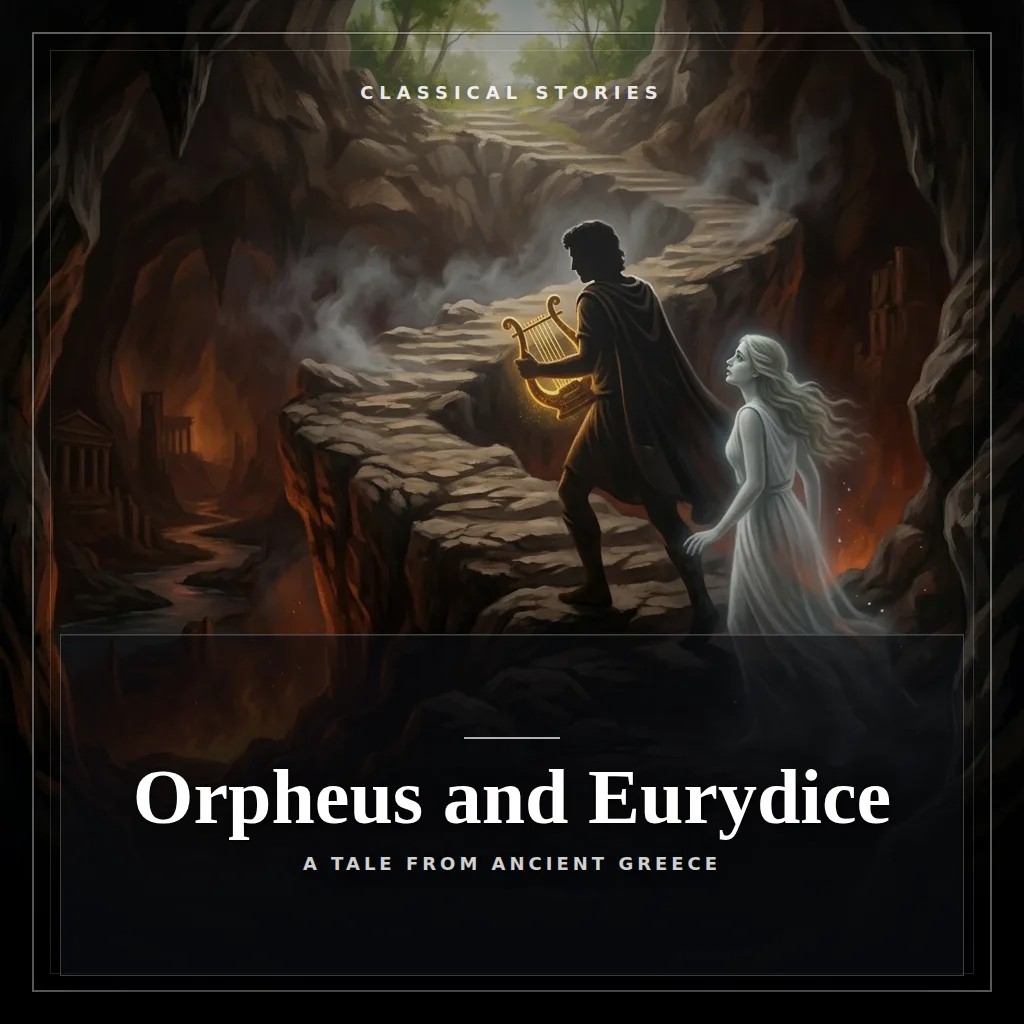
Orpheus plays the lyre the way the rest of us breathe: rivers slow to listen, oaks pull up their roots to follow him, wild wolves lie down beside deer. When his bride Eurydice dies of a serpent's bite on their wedding day, he does what no living soul had dared — walks singing into the underworld itself, past the ferryman, past the three-headed dog, through the fields of the dead who crowd close to hear. Even the iron king of the dead is moved. Eurydice may follow him back to the light on one condition, the simplest and the hardest ever set: walk up, and do not look back until you are both in the sun.
Why it's worth a listen
The season closes with the myth every musician has loved for three thousand years: a singer so good that rivers paused and stones leaned in to listen — and Death itself wept. Orpheus walks into the underworld alive and wins back his bride with nothing but a song; all he must do is not look back. You already know he will. Listen anyway: the walk up is the most suspenseful staircase in all of mythology.
What listeners will learn
Subjects: world stories, literature, cultural literacy.
- character
- setting
- conflict
- choice
- consequence
- theme
- retelling
- orpheus
- eurydice
- classical
Questions for after listening
- Retell the central conflict in order.
- Name one important choice and what happened because of it.
- How did the setting or tradition shape the story?
A question to keep
Why do we look back — and can you forgive someone who does?
Chapters
- The Song That Tamed the World
- The Meadow and the Silence
- The Path into the Dark
- The Song of the Ferryman and the Hound
- Before the Iron Throne
- The Long Walk Up
- A Question to Keep
Read a transcript preview
Long before the world was mapped by ink and paper, when the mountains of Southern Europe were still young, and the forests of Greece grew thick and whispered with the voices of spirits, there lived a young man who did not need weapons to conquer the wild. He did not carry a bronze sword, nor did he wear a helmet of gleaming iron. He carried only a small curved instrument, made of a polished tortoise shell, two wooden arms and seven strings stretched tight. It was a liar, and the young man's name was Orpheus. In the ancient Greek world, a culture that gave us our first great plays, our oldest star maps, and some of the most beautiful stories ever spoken aloud, it was said that Orpheus did not merely play music. He played the way the rest of us breathe, naturally and without effort, as if his heart were beating directly against the strings. The Greeks believed that the gods themselves had given him this gift. His mother was Calliope, the muse of heroic poetry, and his father was said by some to be Apollo, the God of light and music, who had given the boy his very first liar. But whoever his parents were, the music belonged entirely to Orpheus. When Orpheus played, the world did not just listen. It changed. If he walked through a dry, rocky valley where the sun had scorched the earth to dust, he would sit upon a boulder and draw his fingers across the strings. At the first note, a cool breeze would rise from nowhere, carrying the scent of rain. If he played a low winding melody, the rivers would slow their rushing currents, curving backward against their banks, lingering in the bends of the hills, just to keep the sound in their waters a little longer. The great ancient oak trees, whose roots had been buried deep in the dark earth for 300 years, would feel the vibration of his song. Slowly, with a sound like tearing silk and shifting soil, they would slide their massive roots through the dirt, taking clumsy, heavy steps toward him, leaning their leafy crowns close to catch the high clear notes. The very stones on the hillsides, rough, gray and stubborn, would lose their heavy stillness. They would roll down the slopes, not in a dangerous landslide, but gently, settling in a wide, perfect circle around his feet, like sheep gathering around a shepherd. And the animals came too. The wild things of the forest, who spent their lives in fear or in the hunt, forgot their hunger and their terror when Orpheus sang. A mountain wolf with teeth like iron and eyes like yellow glass, would emerge from the thicket, walking slowly, its head lowered. It would slide down into the grass beside a young deer, its flank pressing against the deer's soft fur. Neither moved to run, neither moved to strike. They lay together in the green shade, their breathing rising and falling in time with the rhythm of Orpheus's hands. It was a gift that seemed absolute. It was a power that felt as though it could mend any tear in the fabric of the world, heal any wound, and bring order to any chaos. When people looked at Orpheus, they saw a man who held the keys to the earth's heart. They believed there was nothing his music could not do. But Orpheus was still a mortal man. He lived in a world where the sun rose and set, where the leaves turned gold and fell to the earth, and where every living thing, no matter how beautiful, had to face the end of its song. And for all his power to move the stones and quiet the wolves, Orpheus did not yet know what it was to truly lose something he could not replace. The change came to Orpheus on a spring morning, when the wild clover was thick in the valleys of Thrace. He had spent his youth wandering, playing for kings and Argonauts, but now he found himself drawn to a quiet meadow where the wild bees hummed. It was there that he met Eurydice. Eurydice…
Published 2026-07-10 · Updated