- Who is it for?
- Ages 8–14
- How long is it?
- 54 min
- What does it include?
- Synced read-along and a quiz
- What does it cost?
- Free — no sign-up required
About this audiobook
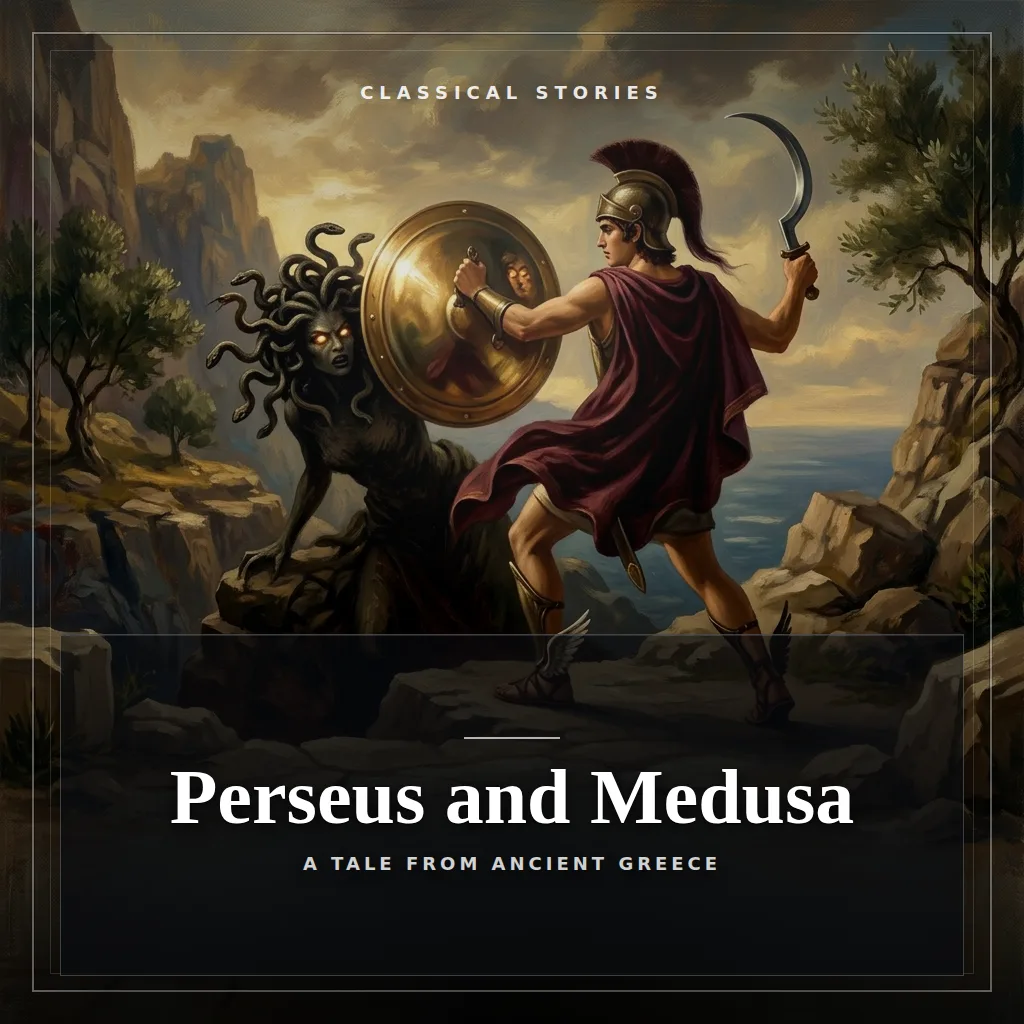
Perseus and his mother Danaë wash ashore in a wooden chest — a king's daughter and grandson, thrown to the sea by a prophecy. Years later another king wants Danaë for himself, and rids himself of her protective son with the oldest trick in the book: extracting a rash promise at a feast. Bring me the head of Medusa, whose gaze turns the living to stone. It is meant to be a death sentence. But the gods lend gifts, three grey sisters share one eye that can be borrowed, and a polished bronze shield can show a monster to a hero without the monster ever meeting his eyes.
Why it's worth a listen
A young hero is sent to fetch the one thing guaranteed to kill him, by a king who simply wants him gone. The answer is the cleverest toolkit in Greek myth — winged sandals, a cap of darkness, a satchel, and a polished shield used as a mirror. And behind the monster waits one of mythology's saddest secrets: Medusa was not always a monster.
What listeners will learn
Subjects: world stories, literature, cultural literacy.
- character
- setting
- conflict
- choice
- consequence
- theme
- retelling
- perseus
- medusa
- classical
Questions for after listening
- Retell the central conflict in order.
- Name one important choice and what happened because of it.
- How did the setting or tradition shape the story?
A question to keep
When a problem cannot be faced head-on, how do you face it?
Chapters
- The Box in the Dark
- The Feast and the Foolish Vow
- Gifts of the Silent Gods
- One Eye in the Grey
- The Garden of Silent Stone
- The Girl on the Edge of the Sea
- A Question to Keep
Read a transcript preview
If you were to stand on the high wind bitten cliffs of the Peloponnese today, and look out over the Aegean Sea, you would see a blue so deep and pure, it looks as though the sky has fallen and pooled in the hollows of the earth. It is a beautiful sea, but it is also a wild one, full of sudden storms and hidden currents. Thousands of years ago, in the land we now call Greece, the people of the Argolid looked out at that same blue water. They were a people who lived by the spear, the plow, and the story. To them, the world was a place where the gods walked in the high mountain mists, where monsters lurked in the uncharted forests, and where a person's destiny was woven by three silent sisters before they were even born. They believed that no matter how fast you ran, how high you built your stone walls, or how deep you dug your foundations, you could never outrun your fate. This is one of their oldest stories. It has been told in many ways, by many voices, over campfires and in great marble halls. But at its heart, it is a story about a problem that could not be faced head-on, and the boy who had to learn how to look at the world sideways to survive. Our story begins in the dark, with the sound of water. Inside a great chest made of thick, dark cedar wood, reinforced with bands of cold iron, a young woman named Danae sat in the pitch black. The air was heavy with the scent of cedar sap and the salt of her own tears. In her arms, wrapped in a woolen cloak that was fast dampening with sea spray, she held her baby boy, Perseus. Every few seconds, the chest would rise with a sickening lurch, hang for a moment in the air, and then drop into the trough of a wave with a shuddering crash that vibrated through Danae's very bones. Water seeped through the tiny seams of the lid, dripping onto her forehead, cold as ice. How had a king's daughter and her newborn son ended up in a wooden box, tossed like a piece of driftwood into the great gray maw of the sea? It was because of fear. Danae's father was Acrisius, the king of Argos. He was a man who ruled with a tight fist and a suspicious heart. For years, Acrisius had wanted a son to inherit his throne, to carry on his name, and to keep his enemies at bay. But the gods gave him only Danae. Desperate, the king had traveled to the sacred temple at Delphi, where the priestess sat in the rising vapors of the earth and spoke the words of Apollo. Acrisius had asked if he would ever have a son. The priestess had opened her eyes, dark and vacant, and whispered a prophecy that made the king's blood run cold. "You will have no son, Acrisius, but your daughter will bear a boy, and by that grandson's hand, you will die." Acrisius returned to Argos a changed man. He looked at his beautiful, gentle daughter and saw only his own death. He could not bear to kill her, for the Greeks believed that the Furies, the terrible spirits of vengeance, would pursue anyone who spilled the blood of their own family. So, he built a chamber of solid bronze, sunk deep beneath the earth, and locked Danae inside it, away from the sun, away from the wind, and away from any man who might marry her. But the gods do not care for the locks of mortal kings. Zeus, the king of the heavens, saw the lonely princess in her bronze prison. He transformed himself into a shower of pure, glittering gold, pouring down through the small air shaft in the roof of the chamber, filling the dark room with light. Nine months later, the cries of baby Perseus echoed through the bronze walls. When King Acrisius discovered the child, his fear turned to madness. He refused to believe a god had visited his daughter. He saw only the prophecy,…
Editorial review
Quality reviewed · 96/100 on . Certificate EL-C050-9D21 is bound to the exact narrated script.
The review checks factual care, audience fit, teaching quality, structure, tone and source honesty. Read the editorial standards.
Published 2026-07-10 · Updated