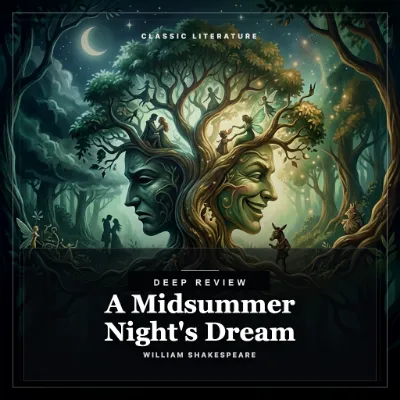
- Who is it for?
- Ages 15–99
- How long is it?
- 35 min
- What does it include?
- Synced read-along and a quiz
- What does it cost?
- Free — no sign-up required
About this audiobook
Shakespeare's tragedy of young love, family feud, speed, language, public violence, private desire, and catastrophic miscommunication.
Why it's worth a listen
Move beyond the romance cliche: show how the play is about youth trapped inside adult systems of honor, haste, family pride, and civic failure.
What listeners will learn
Subjects: literature, drama, language.
- plot
- performance
- tragedy
- comedy
- language
- conflict
- romeo
- juliet
- deep
- review
Questions for after listening
- What problem is this book trying to solve?
- What is one claim or idea you could explain to someone else?
- Compare this book with another view or historical example.
Chapters
- Introduction: Beyond the Balcony Cliché
- The Historical and Intellectual Context of Early Modern Verona
- The Problem This Book Is Trying To Solve
- The Central Argument: Haste, Youth, and Systemic Failure
- Key Concepts: Language, Time, and the Economics of Honor
- Why Scholars and Directors Still Assign This Play
- What Is Brilliant: The Architecture of Doom
- What Is Dangerous, Dated, or Misunderstood
- How to Read and Listen to the Play Without Getting Lost
- Who Should Read This Play Today
Read a transcript preview
Romeo and Juliet: 30-Minute Deep Review William Shakespeare ## 1. Introduction: Beyond the Balcony Cliché Welcome to Emma's Library. This is an original thirty-minute deep review of William Shakespeare's *Romeo and Juliet*, not a full reading of the book. In the popular imagination, *Romeo and Juliet* has been frozen into a single, romantic image: a young woman on a balcony, a young man in the garden below, and a love so pure that it transcends the petty squabbles of the adult world. This cultural shorthand has transformed one of Shakespeare’s most violent, kinetic, and politically devastating plays into a soft-focus greeting card. We are taught to see it as a celebration of romantic love, a tragic but beautiful testament to the power of passion over prejudice. But if we look closely at the text Shakespeare actually wrote in the late sixteenth century, we find something far more unsettling. *Romeo and Juliet* is not a celebration of teenage romance; it is a terrifying diagnostic of a society that consumes its own young. It is a play about civic failure, generational trauma, and the lethal speed of an honor culture that leaves no room for reflection. The tragedy of the play is not that the young lovers die for love, but that they are forced to die because the adult world has created a system where their survival is structurally impossible. In this deep review, we will dismantle the romantic clichés that have accumulated around this text for over four centuries. We will examine the play as a study of speed, showing how Shakespeare compresses time to create a psychological pressure cooker. We will explore the linguistic architecture of Verona, analyzing how the characters are trapped not just by stone walls and family names, but by the very words they are taught to speak. We will look at the civic structures of the city, examining how the failure of the ruling class to police its own elite leads directly to the bodies piled in the Capulet tomb. This is a play where the private whisper is constantly drowned out by the public scream. By shifting our focus from the balcony to the streets, from the idealized lovers to the dysfunctional systems that surround them, we can recover the raw, dangerous energy of Shakespeare’s original vision. We will find a play that is deeply relevant to any society struggling with polarization, where ancient grudges are inherited like genetic traits, and where the young are routinely sacrificed on the altars of adult pride. --- ## 2. The Historical and Intellectual Context of Early Modern Verona To understand why Shakespeare’s audience found *Romeo and Juliet* so electric, we must first understand the world in which it was produced. Written around 1597, during the twilight of Queen Elizabeth the First’s reign, the play emerged at a moment of profound social and political anxiety in England. London was a rapidly growing metropolis, teeming with young apprentices, plagued by economic instability, and haunted by the constant threat of civil disorder. The memory of the Wars of the Roses, which had torn England apart in the previous century, was still a potent political ghost. The fear of what would happen when the childless Elizabeth died was a pressing concern for every thinking citizen. In this context, Shakespeare’s choice of Verona as a setting was highly deliberate. For Elizabethans, Italy was a place of intense imaginative contradiction. On one hand, it was the cradle of the Renaissance, the source of humanism, fashion, and sophisticated literature. On the other hand, in the Protestant English imagination, Italy was a den of Catholic corruption, Machiavellian intrigue, and uncontrolled passion. It was a place where the blood ran hot, where revenge was a formal art, and where the knife was always close at hand. By setting the play in Verona, Shakespeare was able to create a psychological distance that allowed his audience to contemplate their own anxieties about civic violence and generational conflict without directly criticizing the Tudor state. Furthermore, Shakespeare did not invent this story. He adapted it from a long line of narrative ancestors, most directly from Arthur Brooke’s 1562 poem, *The Tragicall Historye of Romeus and Juliet*. Brooke’s poem was a…
Editorial review
Quality reviewed · 97/100 on . Certificate EL-BA6F-18B1 is bound to the exact narrated script.
The review checks factual care, audience fit, teaching quality, structure, tone and source honesty. Read the editorial standards.
Published 2026-07-06 · Updated