- Who is it for?
- Ages 15–99
- How long is it?
- 38 min
- What does it include?
- Synced read-along and a quiz
- What does it cost?
- Free — no sign-up required
About this audiobook
Mill's liberal argument that women's legal and social subordination is unjust, untested by freedom, damaging to marriage and talent, and sustained by law, education, and custom.
Why it's worth a listen
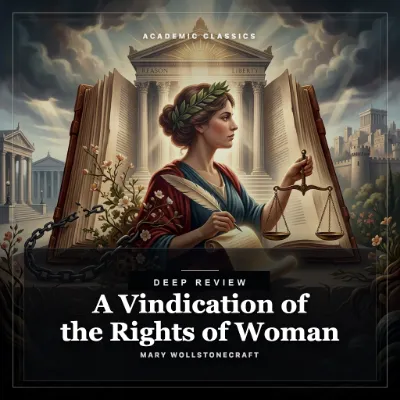
Place Mill beside Wollstonecraft and Harriet Taylor Mill, explaining the force of his equality argument while examining paternalism, class limits, imperial context, and the gap between formal liberty and structural power.
What listeners will learn
Subjects: law, civics, political thought.
- law
- rights
- punishment
- authority
- due process
- legal reform
- subjection
- women
- deep
- review
Questions for after listening
- What problem is this book trying to solve?
- What is one claim or idea you could explain to someone else?
- Compare this book with another view or historical example.
Chapters
- Introduction: An Original Review of Mill's Radical Treatise
- The Intellectual Crucible: Wollstonecraft, Harriet Taylor, and the Victorian Landscape
- The Central Problem: The Legal and Social Subjugation of Women
- Deconstructing 'The Nature of Women': The Artificiality of Gender
- Marriage as Legal Slavery and the Ideal of Co-Partnership
- Public Spheres, Education, and the Economy
- The Brilliant Mechanics of Mill's Argument: Liberty and Utility
- Blind Spots and Boundaries: Class, Empire, and the Limits of Liberalism
- Reception, Legacy, and Later Feminist Critiques
- How to Read 'The Subjection' Today and Who It Is For
Read a transcript preview
The Subjection of Women: Deep Review John Stuart Mill ## 1. Introduction: An Original Review of Mill's Radical Treatise Welcome to this classic book deep review of John Stuart Mill’s eighteen sixty-nine landmark essay, *The Subjection of Women*. Before we begin our analysis, please note that this is an original, comprehensive deep review and critical commentary. It is not a reading of the source text itself, nor does it rely on long, unmediated quotations. Instead, this episode offers an in-depth scholarly examination of the work’s historical context, its philosophical architecture, its rhetorical brilliance, and its significant limitations. Our goal is to provide adult learners and advanced students with a rigorous, fair, and historically grounded guide to one of the most influential texts in the history of liberal political philosophy and feminist thought. When *The Subjection of Women* was published in London in eighteen sixty-nine, it arrived like a philosophical firebrand in the highly structured, deeply conservative landscape of Victorian England. John Stuart Mill, who was already widely respected as one of the preeminent public intellectuals of the English-speaking world, a former Member of Parliament, and a systematic philosopher of liberty and utilitarianism, took a public stance that many of his contemporaries viewed as scandalous, unnatural, and dangerous. Mill argued that the legal and social subordination of women to men was not only fundamentally unjust in itself, but that it constituted one of the single greatest obstacles to the moral, intellectual, and social progress of humanity. Many modern readers begin from a commitment to women's full legal, political, and social equality, although that commitment is neither universally accepted nor realized worldwide. Reading Mill only through present-day assumptions can obscure how disruptive his case was in Victorian Britain. He was not merely asking for minor reform or kinder paternalism; he challenged the legal, economic, and psychological structure of male authority. Throughout this deep review, we will place Mill’s text in its rich intellectual and historical context. We will examine how his arguments were shaped by his predecessors, most notably Mary Wollstonecraft, and by his profound intellectual partnership with his late wife, Harriet Taylor Mill. We will dissect the four chapters of the essay, exploring Mill’s deconstruction of the supposed natural differences between the sexes, his scathing critique of Victorian marriage as a form of legal slavery, his demand for women's access to education and the professions, and his defense of female suffrage. At the same time, our review will remain balanced and critical. We will not shy away from examining the boundaries and blind spots of Mill’s liberal framework. We will analyze how his class position as a member of the British bourgeoisie limited his understanding of domestic labor, how his paternalistic assumptions occasionally surface, and how his position as an official of the East India Company ties his work to broader imperial narratives of civilization and progress. By examining both the brilliance and the historical limits of *The Subjection of Women*, we can understand why this text remains a staple of academic curricula and how it continues to challenge our understanding of the gap between formal legal equality and genuine structural power. --- ## 2. The Intellectual Crucible: Wollstonecraft, Harriet Taylor, and the Victorian Landscape To understand why *The Subjection of Women* was so revolutionary, we must first reconstruct the intellectual and legal landscape from which it emerged. Mill was not the first writer in the English tradition to advocate for the rights of women. Nearly eight decades earlier, in seventeen ninety-two, Mary Wollstonecraft had published her pioneering work, *A Vindication of the Rights of Woman*. Wollstonecraft’s treatise was a passionate, revolutionary call for women’s education, arguing that the apparent intellectual deficiencies of women were the result of a degraded upbringing and a society that trained them for frivolity. Yet, by the time Mill was writing in the late eighteen-sixties, Wollstonecraft’s legacy had been marginalized, often associated with the perceived excesses of the French Revolution and her own unconventional personal life. Furthermore, while Wollstonecraft’s argument was primarily moral and educational, Mill sought to construct a systematic, legal, and utilitarian case that would appeal to the hard-headed, reform-minded Victorian male elite. Mill’s work was designed to show that the subjugation of women…
Editorial review
Quality reviewed · 96/100 on . Certificate EL-FCB6-6B9E is bound to the exact narrated script.
The review checks factual care, audience fit, teaching quality, structure, tone and source honesty. Read the editorial standards.
Published 2026-07-19 · Updated