- Who is it for?
- Ages 15–99
- How long is it?
- 29 min
- What does it include?
- Synced read-along and a quiz
- What does it cost?
- Free — no sign-up required
About this audiobook
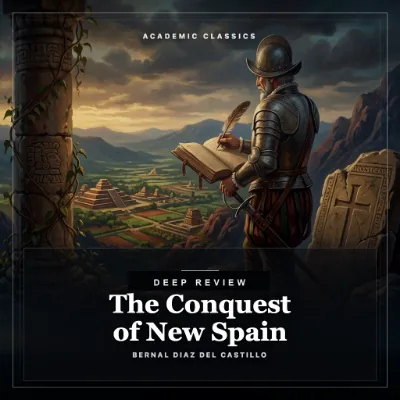
Prescott's influential nineteenth-century narrative history of the Spanish conquest of Mexico, admired for drama and style but shaped by its era's assumptions.
Why it's worth a listen
Use Prescott to show how history can be both powerful literature and a document of its own age: compelling, consequential, and in need of critical reading.
What listeners will learn
Subjects: history, historiography, political context.
- primary source
- historical argument
- evidence
- perspective
- causation
- legacy
- history
- conquest
- mexico
- deep
Questions for after listening
- What problem is this book trying to solve?
- What is one claim or idea you could explain to someone else?
- Compare this book with another view or historical example.
Chapters
- Introduction: The Double Mirror of History
- The Problem This Book Is Trying to Solve
- The Central Argument and Narrative Arc
- Key Concepts: Romantic Historiography and Providence
- Why Scholars Still Assign Prescott
- What Is Brilliant: The Literary Architecture of the Conquest
- What Is Dangerous or Dated: The Blind Spots of the Nineteenth Century
- How Prescott Shaped Later Thought and National Mythologies
- How to Read This Book Without Getting Lost
- Who Should Read This Book Now
Read a transcript preview
The History of the Conquest of Mexico: 30-Minute Deep Review William H. Prescott ## 1. Introduction: The Double Mirror of History Welcome to Emma’s Library. This is an original thirty-minute deep review of William Hickling Prescott’s monumental work, *History of the Conquest of Mexico*, first published in 1843. This episode is not a reading of the source text, but rather a critical, contextual, and literary exploration of one of the most influential works of history ever written in the United States. Our goal today is to examine this book as a double mirror. When we read Prescott’s vivid, symphonic narrative, we are looking through a glass that reflects two distinct eras at once: the dramatic, world-altering collision between the Spanish Empire and the Aztec Triple Alliance in the early sixteenth century, and the intellectual, political, and racial anxieties of the young United States in the mid-nineteenth century. Prescott was a Boston patrician, a scholar who worked in near-blindness, yet he managed to construct a narrative so compelling and visually rich that it shaped how generations of readers imagined the Americas. For over a century, his interpretation of Hernán Cortés, Moctezuma, and the fall of the magnificent city of Tenochtitlan was accepted as standard historical truth. Today, however, we read Prescott with a mixture of admiration and caution. We admire his pioneering archival research, his extraordinary literary pacing, and his ability to synthesize disparate, chaotic primary sources into a cohesive epic. At the same time, we must confront the limitations of his perspective—his Eurocentrism, his reliance on nineteenth-century theories of racial hierarchy, and his tendency to frame imperial conquest as an inevitable march of Christian progress. To engage with Prescott’s *Conquest of Mexico* is to participate in the discipline of historiography, which is the study of how history itself is written. We learn that history is never a neutral recording of facts; it is an act of translation, curation, and storytelling. As we journey through Prescott’s narrative, we will explore the historical context of his writing, the central arguments he put forward, the literary brilliance that keeps his work alive, and the dangerous biases that require us to read him with a critical, modern eye. This is a journey into the heart of historical myth-making, where the pen of a nineteenth-century Bostonian proved to be as powerful and enduring as the swords of the conquistadors. ## 2. The Problem This Book Is Trying to Solve To understand why Prescott wrote this book, we must transport ourselves to the intellectual landscape of New England in the late 1830s and early 1840s. The United States was a young nation, still self-conscious about its lack of a deep, ancient literary tradition. American intellectuals felt a profound pressure to prove that the New World could produce scholarship and literature that rivaled the great minds of Europe. At the same time, the nation was expanding rapidly westward, driven by a growing belief in its own exceptional destiny. In this environment, history was not seen merely as an academic pursuit, but as a moral and national project. The problem Prescott faced was twofold. First, there was no comprehensive, literary history of the Spanish conquests in the Americas written from a modern, philosophical perspective. The existing accounts were either dry, bureaucratic Spanish chronicles, biased religious tracts, or polemical European histories that dismissed the Americas as a degenerate continent. Prescott wanted to rescue this history from obscurity and prejudice, presenting it as a grand, tragic epic that belonged to the shared heritage of the Western Hemisphere. Second, Prescott was writing against the backdrop of the "Black Legend"—the traditional Protestant view of Spain as an exceptionally cruel, backward, and fanatical empire. While Prescott shared many of the anti-Catholic biases of his Boston Unitarian milieu, he sought to write a history that was more balanced and objective than previous accounts. He wanted to understand the conquistadors not as mere monsters, but as complex human beings driven by a combination of religious zeal, medieval chivalry, and Renaissance ambition. There was also a deeply personal problem that Prescott had to overcome. While a student at Harvard, a stray crust of bread thrown during a dining hall fracas struck him in the left eye,…
Editorial review
Quality reviewed · 98/100 on . Certificate EL-A38F-AFAE is bound to the exact narrated script.
The review checks factual care, audience fit, teaching quality, structure, tone and source honesty. Read the editorial standards.
Published 2026-07-06 · Updated